Showing posts with label Philosophy. Show all posts

Thursday, October 26, 2017

Cleaning out some files: Paulo Freire, philosopher

In clearing out some files in my old filing cabinet, I had come across some interesting articles that were required reading for a philosophy of education course I had taken eons ago.

In the clearing out process, there remained a little pile of articles on Paulo Freire, that I caught my attention and I wanted to read again, which I managed to do this evening.

Freire seems to be a mixture of liberation Catholic, revolutionary, educator of adults for literacy, Marxist dialectician, critic of traditional arrangements, colonialism and promoter of just society helper of the poor and oppressed.  There seems to be a little Freire for everyone, and certainly I can find a lot of places where I sympathize with him, from what I can glean.

Never having lived in conditions of poverty myself, I can probably not grasp the breadth and depth of his passion and vision. I have been to northern Canadian aboriginal reserves that might provide some similar conditions.  There was hunger, poor education, despair and isolation.  My father was a refugee, and I know terrible conditions from stories told in the family.  I am only one generation away from the family having had nothing and running for their lives.  But the family was not spiritually dead or impoverished, partly because the great works had been passed down, because people knew things by heart and because they were Christians.  There, I disagree with Freire's emphasis on letting go of  what he calls "banking" education.  This is a grave mistake.  And also Dewey was wrong on a lot of things.  (This is why we have American presidents who can't speak English, in the land of sects.)

However, as a Lutheran, I also see that in some sense Freie is a "Lutheran".  Five hundred years ago, Martin Luther posted theses to be debated that highlighted the oppression of the church by the Roman Catholic hierarchy.  A great revolution of sorts resulted. Humanistic education and freedoms of the university, literacy, including biblical literacy, a proper care of souls in the congregation and social assistance were brought about.

Portuguese  Catholicism may have brought something to Brazil, that Freire knew  in his day that was wrong, but that had been let go in other places quite some time before. But bringing in a type of Marxist communism or National Socialism (Nazi's), any sort of leader-focused revolution toppling existing orders of society have proven to be some of the most oppressive systems ever invented by man.  The next elite fights its way to the top, inevitably quite quickly to oppress now without conscience or impediment. We did not know some particular horrors before these leaders and revolutionaries invented them in their great reflective creativity.  They became monsters.  We must see this with clear eyes.  There is something very wrong with the theories. We may let go of Catholic hierarchy and of edicts from Rome and councils, but as Luther said, we must not let go of the word of God.  Where we abandon it, we get into deep trouble.  In some places, a Catholic political party has stood in the way of oppressive alternatives.  There are all sorts of scenarios.

The poor we always have with us, and we should deeply involve ourselves in the troubles and needs of this world and our neighbors. This is true.  Love cannot just be a word or theory.  Freire is right, there.  But some of the centuries old Reformation ideas already came to grips with some of these issues without jettisoning what was right from before.  It was a conservative revolution.

In briefly checking the history of Brazil on Wikipedia, I see that it interestingly concludes with this point about the changing religious landscape:


Until recently Catholicism was overwhelmingly dominant. Rapid change in the 21st century has led to a growth in secularism (no religious affiliation). Just as dramatic is the sudden rise of evangelical Protestantism to over 22% of the population. The 2010 census indicates that fewer than 65% of Brazilians consider themselves Catholic, down from 90% in 1970. The decline is associated with falling birth rates to one of Latin America’s lowest at 1.83 children per woman, which is below replacement levels. It has led Cardinal Cláudio Hummes to comment, "We wonder with anxiety: how long will Brazil remain a Catholic country?"[47]

Image result for Paulo Freire


If I get around to it, I would like to read more about his ideas on adult education and literacy.


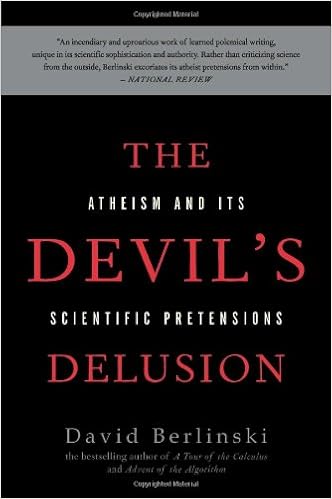
Image may contain: 1 person, smiling, eyeglasses and text


Friday, May 13, 2016

I am reading a book by David Berlinski / also a video

I am reading a book:

The Devil's Delusion: Atheism and its Scientific Pretensions


by David Berlinski


Very, very good.  The ironies and the occasional and very funny sarcasm are so well perceived and communicated, you must cheer for the man.  I will actually read the book twice, I think--something I never do--and underline afterward. 

Also see this video of an event "Socrates in the City" with Berlinsy and Metaxas. 


Monday, October 28, 2013

Miscellaneous / Philosophers / Writing critically

1.  The weirdest philosophers:

http://www.examiner.com/article/top-7-weirdest-philosophers?cid=db_articles

I have absolutely no idea why such stuff interest me.  Or irks me.  (What is the difference?)  I should focus on important writers not these who have themselves lost in the maze.


2.  On the coffee table still sits the William Zinsser  "On Writing Well.  The classic guide to writing non-fiction".  It is very enjoyable and I love the examples he provides.  They illustrate his points and also some of the non-fiction of life.  Hopefully, it has ever so slightly improved the writing on this blog.  I have attempted to cut out superfluous and extraneous words and thoughts.

But I am only on page 195.  Here I want to quote him because he makes the same point that Chesterton made a few posts back:  a critic should be someone who loves the subject matter.  It also connects to the last post:  someone who hates everything and denounces everything quickly becomes a bore.

Quote:

"Yet I suggest several conditions that apply to both good reviewing and good criticism.  One is that critics should like--or better still, love--the medium they are reviewing.  If you think movies are dumb, don't write about them.  The reader deserves a movie buff who will bring along a reservoir of knowledge, passion and prejudice.  It's not necessary for the critic to like every film;  criticism is only one person's opinion.  But he should go to every movie wanting to like it.  If he is more often disappointed than pleased, it's because the film has failed to live up to its best possibilities.  This is far different from the critic who prides himself on hating everything.  He becomes tiresome faster than you can say 'Kafkaesque.' "

Tuesday, October 1, 2013

Nietzsche

Yesterday was my errand day and I always drive to CBC radio playing.  The station seems to have been recycling many shows be it summer break or new fall season.  So, amazingly, in the plain middle of the afternoon we got a show on the philosopher Friedrich Nietzsche from the IDEAS program.  Usually, IDEAS is on after 8:00 or 9:00 PM.--Well, here I sat in front of Costco, and the radio was in the middle of Nietzsche.  I listened for another ten minutes and took a few notes.  There were three Canadian scholars providing information and discussion.  One was a female French Canadian and I lost my confidence in here when she described Kierkegaard as a Christian (as opposed to Nietzsche).  From what I've seen of Kierkegaard he is the father of existentialism, not a Christian, certainly not in the orthodox sense, which is the only sense to me.  The other one was from the philosophy department of the University of Toronto and I forget the third, another female who brought in a lot about Homer and heroes.

Anyhow, in a way I think that I know already more than enough about Nietzsche from various programs and discussions--more than I really care to know.  But he keeps on coming up, and this program was focusing on his philosophy as in opposition to Christianity, the way he characterized a "slave morality" as something characteristic of Christianity and how impoverishing it is.  We, of course, know that Nietzsche went mad, and we have our theories as to how this happened, my own ideas running with the thought that he directly opposed the "slave morality" and contracted some nasty viruses.

It seems, if one were to decide to read him, that he ought to be read him in German.  Some English speaking friends say that he is unreadable.  But I have read little bits of Nietzsche in German and found those bits quite exquisite.  He did know how to write.   One might read him just for that.

To illustrate the language barrier, one of the professors on the CBC program spoke about a phrase or title of a book "Der tolle Mensch" which is generally translated as "The mad human" , or something implying insanity.  She said that in current German "toll" also means "great", "fantastic".  This is true.  So when you say "Der tolle Mensch", there are a number of interpretations possible and various connotations that will never be caught in English.  So, if I were to read him, I would read him in German.

I did look at I-books.  For $10.00 you can have the collected works in German.  I am thinking about it.  Three bucks, four bucks, yes.  Ten bucks.  I don't know. --Is Nietzsche worth ten bucks to me? -- Probably not.


We can see that you can even get baby clothes with Nietzsche quotes, on Amazon.  Thankfully, the baby is real and the poop in the diaper is, too.  Thankfully, the real world is real. -- Anyone who has ever dreamed of having a baby, "imagined" a baby, and run into the wall of infertility knows very well that the real is much bigger and better than the imaginary.


Friday, July 5, 2013

Chronicle of Higher Education on William Lane Craig

http://chronicle.com/article/The-New-Theist/140019/

Here is a current article on William Lane Craig "The New Theist".  I've watched William Lane Craig's debate in Mexico.  Three hours, available on Youtube.  There are other talks I should get to as time permits.


Thursday, July 4, 2013

Mind and Cosmos / Finished

Let's finish Mind and Cosmos.

Nagel shows that many important things or concepts exist outside of our physical selves, such as reason itself, and values.  Something exists whether I perceive it or not.

"Thought and reasoning are correct or incorrect in virtue of something independent of the thinker's beliefs, and even independent of the community of thinkers to which he belongs.  We take ourselves to have the capacity to form true beliefs about the world around us, about the timeless domains of logic and mathematics, and about the right thing to do.  We don't take these capacities to be infallible, but we think they are often reliable, in an objective sense, and that they can give us knowledge.  The natural internal stance of human life assumes that there is a real world, that many questions, both factual and radical, have correct answers, and that there are norms of thought which, if we follow them, will tend to lead us toward the correct answers to those questions.  It assumes that to follow those norms is to respond correctly to values or reasons that we apprehend.  Mathematics, science, and ethics are built on such norms.

It is difficult to make sense of all this in traditional naturalistic terms.  Unless we are prepared to regard most of it as an illusion, this points to a further expansion of our conception of the natural order to include not only the source of phenomenological consciousness--sensation, perception, and emotion--but also the source of our active capacity to think our way beyond those starting points.  The question is how to understand mind in its full sense as a product of nature--or rather, how to understand nature as a system capable of generating mind. 

...But once we come to recognize the distinction between appearance and reality, and the existence of objective factual or practical truth that goes beyond what perception, appetite, and emotion tell us, the ability of creatures like us to arrive at such truth, or even to think about it, requires explanation.  An important aspect of this explanation will be that we have acquired language and the possibilities of interpersonal communication, justification, and criticism that language makes possible.  But the explanation of our ability to acquire and use language in these ways presents problems of the same order, for language is one of the most important normatively governed faculties.  To acquire a language is in part to acquire a system of concepts that enables us to understand reality. 

I am going to set aside at this point all the problems mentioned earlier about the probability of the origin of life and the sufficiency of random mutation and natural selection to account for the actual evolutionary history of life on earth.  The question I want to raise remains even if those problems can be solved for the evolution of plants and lower animals...  The problem has two aspects.  The first concerns the likelihood that the process of natural selection should have generated creatures with the capacity to discover by reason the truth about a reality that extends vastly beyond the initial appearances--as we take ourselves to have done and to continue to do collectively in science, logic, and ethics.  ...  The second problem is the difficulty of understanding naturalistically the faculty of reason that is the essence of these activities.  I will begin by considering a possible response to the first problem, before going on to the second, which is particularly intractable."  (Nagel, Mind and Cosmos, Oxford, pp. 72-74)


These are the main problems he wishes to explore and he does so in the remaining pages.  The last bit, following, is from his conclusion.

"Philosophy has to proceed comparatively.  The best we can do is to develop the rival alternative conceptions in each important domain as fully and carefully as possible, depending on our antecedent sympathies, and see how they measure up.  That is a more credible form of progress than decisive proof or refutation.

In the present climate of a dominant scientific naturalism, heavily dependent on speculative Darwinian explanations of practically everything, and armed to the teeth against attacks from religion, I have thought it useful to speculate about possible alternatives.  Above all, I would like to extend the boundaries of what is not regarded as unthinkable, in light of how little we really understand about the world.  It would be an advance if the secular theoretical establishment, and the contemporary enlightened culture which it dominates, could wean itself of the materialism and Darwinism of the gaps--to adapt on of its own pejorative tags.  I have tried to show that this approach is incapable of providing an adequate account, either constitutive or historical, of our universe.  

However, I am certain that my own attempts to explore alternatives is far too unimaginative.  An understanding of the universe as basically prone to generate life and mind will probably require a much more radical departure from the familiar forms of naturalistic explanation that I am at present able to conceive.  Specifically, in attempting to understand consciousness as a biological phenomenon, it is too easy to forget how radical is the difference between the subjective and the objective, and to fall into the error of thinking about the mental in terms taken from our ideas of physical events and processes.  Wittgenstein was sensitive to this error, though his way of avoiding it through an exploration of the grammar of mental language seems to me plainly insufficient.  

It is perfectly possible that the truth is beyond our reach, in virtue of our intrinsic cognitive limitations, and not merely beyond our grasp in humanity's present stage of intellectual development.   But I believe that we cannot know this, and that it makes sense to go on seeking a systematic understanding of how we and other living things fit into the world.  In this process, the ability to generate and reject false hypotheses plays an essential role.  I have argued patiently against the prevailing form of naturalism, a reductive materialism that purports to capture life and mind through its new-Darwinian extension.  But to go back to my introductory remarks, I find the view antecedently unbelievable--a heroic triumph of ideological theory over common sense.  The empirical evidence can be interpreted to accommodate different comprehensive theories, but in this case the cost in conceptual and probabilistic contortions is prohibitive.  I would be willing to bet that the present right-thinking consensus will come to seem laughable in a generation or two--though of course it may be replaced by a new consensus that is just as invalid.  The human will to believe is inexhaustible." (Nagel, Mind and Cosmos, pp. 127 and 128.) 


OK, I think that Nagel has made himself perfectly clear.  The man is so clear, I must love him for it.  And what could one add?

I have young persons in my life, strict atheists who study psychology and who insist that all of human life comes town to atoms and molecules.  I have people on the internet, who howl the moment you dare to contradict Richard Dawkins in the slightest.  I am a biology major and had the evolutionary concepts shoved down my throat.  However, none of those concepts stood up to learning about cell biology.  Just one single cell is a miracle above miracles.  If the stars and the universe have not make you shudder with reverence, then the single cell could do it.

Nagel gets all this and goes beyond it.  It is consciousness, language and rationality which are even more astounding, with all naturalistic explanations just as inadequate.  Basically, all of it is stupendously grand and our theories are insufficient or laughable.  Not that he has given up looking and thinking.

To most people all this serves to witness to the glory of the Creator, his mind, his wisdom, his language, his revelation, his love. Nagel did not go anywhere near love, and this is the very greatest thing to contemplate.  Of all the things that make us human we find that the best.  Certainly, there is the biological component, but hardly would we be satisfied with a mere biological explanation or purpose.


Thursday, June 27, 2013

"Die Philosoffen" by the Wise Guys / A little satire about the philosophers

Half way through the Nagel.  It is all so painfully obvious, one can fly through it.  I hope that Richard Dawkins read it.  No doubt he has.  We haven't heard so much from him lately, and Hitchens is dead.  They are/were both so smart, it's amazing how wrong they can be. It seems the smarter you are the wronger you can be. There is an aphorism by me.  I believe that I just invented it.  Only problem: it is so painfully obvious.

On Facebook, the other day, a pastor from Germany shared this song about the philosophers.  See the video and the German text below.  I have inserted my English translation between each verse.   Good fun.  

In checking now, I see that he has removed this piece from his newsfeed.  He must have felt is a little out of place after several days.

The group is called "Wise Guys".  Their lyrics are all quite witty, but in German language.  Their texts can be found here.  http://wiseguys.de/songtexte/detail%C2%ADs/die_philosoffen/

Just the title of this song "Die Philosoffen" is a word play on "philosophers" and "being drunk" ("besoffen").  But I will endeavor to translate this one for the general hilarity of it.  See below.


or here:   http://youtu.be/E8Ilr_YtEjs


Der Mann Aristoteles
war blöd, doch ich erzähl es:
Er spielte Philosoph
und fragte wie Klein Doof:
"Warum ist etwas da,
das da vorher noch nicht war?
Hmm...das hat bestimmt 'nen Grund!"
Vielen Dank für diesen Fund.

The man Aristotle,
was a bit silly, but I will tell the story,
he liked to play philosopher,
and simply asked plain stupid,
"Why is something here,
that was not here before?
That must have a cause!"
--thank you very much for this great discovery!

Ein Mann, genannt Diogenes,
der tat was Ungezogenes:
Er hat, wie alle wissen,
sich selber weggeschmissen.
So lebte er mit Wonne
in einer dicken Tonne,
und das war ein echter Renner -
heute macht des jeder Penner.

There was a man, called Diogenes,
he did something pretty unheardof.
He threw himself away into a big
barrel and lived in there,
--this was truly a big hit,
--nowadays every tramp does the same.

Die Philosoffen waren alle besoffen!
Das ist kein Witz und auch kein Neid:
Die waren breit, die ganze Zeit.
Die Philosoffen waren alle besoffen!
Liest man nur kurz in ihren Texten,
merkt man, dass sie Wodka exten.
Wahrheit ist zu später Stund'
eben ein Fass ohne Grund.
Doch mal ganz offen:
Das lässt mich hoffen,
dass man's im Leben zu was bringt,
wenn man trinkt.

The philosophers,
were all drunk.
We are not saying this as a joke or from envy.
They were broad (drunk?), the the whole time.
If you read only a little in their writings,
you can see that they were oozing vodka.
But truth, at a late hour,
is simply a barrel without a bottom.
But let us say this,
it gives me hope,
that one can get somewhere in life,
by being drunk.

Ein Mann, der Schopenhauer,
der macht mich wirklich sauer:
Der hatte einen Willen,
den konnt er aber nicht stillen.
Er fand, es sei Beschiss,
dass die Welt ist, wie sie is'.
Nun, das ist uns allen klar -
Schopi machte das zum Star.

There was a man, the Schopenhauer,
he makes me really quite sour.
He had a "will", 
which he could not fullfill.
He found that the word is crap,
the way it is.
Now, that's something we all knew,
but this recognition made Schopi a star.


Ein Mann mit Namen Hegel,
das war ein rechter Flegel:
der konnte etwas meinen
und es gleichzeitig verneinen.
Er widersprach sich ständig.
Das fand man wohl sehr wendig,
und man nannte diese Hektik
hochtrabend 'Dialektik'.

There was a man, named Hegel,
he was a real troublemaker,
he could mean something and deny it at the same time.
He contradicted himself constantly,
and people thought that was flexible,
and this type of hectic,
one proudly called a dialectic.

Die Philosoffen waren alle besoffen!
Sie sah'n der Wahrheit ins Gesicht
und waren hackestrunzendicht.
Die Philosoffen waren alle besoffen!
Liest man nur kurz in ihren Werken,
merkt man, wie sich Denker stärken:
Mit 'nem tiefen Blick ins Glas -
in vino veritas!
Doch mal ganz offen:
Das lässt mich hoffen,
dass es im Leben besser läuft,
wenn man säuft!

The philosophers were all drunk!
The looked the truth right in they eye,
and remained as dumbstruck as before.
The philosophers were all drunk!
If you briefly read in their works,
you can see quickly, how a 
thinkers strengthens himself:
with a deep look into the glass,
in vino veritas!
But let me say this,
all this gives me hope,
that life goes better,
when you drink.

Ein Mann - das war der Platon -
da erzähl' ich euch noch grad von,
der wollt' was von Sokrates,
doch Sokrates, der verbat es.
Drum erfand der Platon Liebe,
die auskommt ohne Triebe -
na, wie soll denn das jetzt gehn?!
Im Suff hat man Ideen!

There was a man, his name was Plato,
I will quickly tell you about him.
He wanted something from Socrates,
but Socrates forbade it.
Therefore, Plato invented love,
which gets away without urges.
Well, how is that supposed to work?
When drunk one has some strange ideas.


Die Philosoffen waren alle besoffen!
Sie waren voll bis unter'n Rand,
das nennt sich nüchterner Verstand.
Die Philosoffen waren sowas von besoffen!
Liest man nur kurz in ihren Schriften,
merkt man, dass sie wohl auch kifften:
Erst 'ne große Tüte bau'n
und dann die Wahrheit schaun'!
Doch mal ganz offen:
Das lässt nicht hoffen!
Ich bin betroffen
und könnt mich zoffen,
denn mir wird auf einmal klar,
was der Grund des Übels war -
drum ist alles schief gelaufen
und sie fingen an zu saufen,
waren sie auch noch so schlau:
Ihnen fehlte was.
Na, was war denn das?
Na, was wohl? Ja, genau: Eine...


The philosophers were all drunk!
They were rather plastered,
and now we call it sober reason.
The philosophers were drunk,
if you briefly read their writings
...
suddenly it becomes clear to me
what the real problem was,
this is why everything went wrong,
and why they started to drink,
because even though they were smart,
something was missing.
Well, what was it?
Well, what?  Yes, certainly...
a .....

(Frau:  woman)


...Frau findet man schwerlich
in der Philosophie, doch mal ehrlich,
es wäre auch verlogen,
zu sagen: Frauen nehmen keine Drogen.
Und doch ist etwas anders
als beim Mann. Ja, Mann, was kann das
denn nur sein? Ich denk und denk...
Jetzt brauch ich erst mal ein Getränk!


... a "woman" is hard to find in philosophy,
let's be honest.
And it would be a lie to say,
that women don't take drugs,
but still it is something different than with a man.
With a man it is, 
what is it,
I think and think...
I think I need a drink!

Wednesday, June 26, 2013

Mind and Cosmos / Nagel

"Mind and Cosmos" by Thomas Nagel came in the mail, yesterday, from Amazon.  It's not just used Reader's Digest Music Books I've bought, lately.  (The music books come but I am amazed how few of the songs I know.  We are not talking Bach, Schubert, hymns or hiking songs.  When my children were little I first learned of "Hickory Dickory Dock" and such treasures. Then at Christmas, in playschool, they sang:  "Santa Claus is coming to town."  I was outraged at the terrible theology.  How quaint. But this lies some decades back now.  At present I need to learn the songs from the 20's, 30's and 40's.  Yup.)

So, with the songs books not resonating right of the bat, or not at all, I have already thrown myself onto the "Mind and Cosmos", overnight.  How beautifully Nagel turns the phrases and injects good sense into the discussion.  How refreshing.

Also see this post and link to National Post article on the reaction to Thomas Nagel.

Let's give a little from Chapter 1: Introduction.


"Scientists are well aware of how much they don't know, but this is a different kind of problem--not just of acknowledging the limits of what is actually understood but of trying to recognize what can and cannot in principle be understood by certain existing methods."

"The starting point for the argument is the failure of psychophysical reductionism, a position in the philosophy of mind that is largely motivated by the hope of showing how the physical sciences could in principle provide a theory of everything.  If that hope is unrealizable, the question arises whether any other more or less unified understanding could take in the entire cosmos as we know it...What I would like to do is to explore the possibilities that are compatible with what we know--in particular what we know about how mind and everything connected with it depends on the appearance and development of living organisms, as a result of the universe's physical, chemical, and then biological evolution.  I will contend that these processes must be reconceived in light of what they have produced, if psychophysical reductionism is false.  

The argument from the failure of psychophysical reductionism is a philosophical one, but I believe there are independent empirical reasons to be skeptical about the truth of reductionism in biology.  Physico-chemical reductionism in biology is the orthodox view, and any resistance to it is regarded as not only scienifically but politically incorrect.  But for a long time I have found the materialist account of how we and our fellow organisms came to exist hard to believe, including the standard version of how the evolutionary process works.  The more details we learn about the chemical basis of life and the intricacy of the genetic code, the more unbelievable the standard historical account becomes.  (Footnote:  See Richard Dawkins, The Blind Watchmaker:  Why the Evidence of Evolution Reveals a Universe without Design, for a canonical exposition, which seems to convince practically everyone.)  [Snort.  Hahahaha.]  This is just the opinion of a layman who reads widely in the literature that explains contemporary science to the nonspecialist.  Perhaps that literature presents the situation with a simplicity and confidence that does not reflect the most sophisticated scientific thought in these areas.  but it seems to me that, as it is usually presented, the current orthodoxy about the cosmic order is the product of governing assumptions that are unsupported, and that it flies in the face of common sense. 

I would like to defend the untutored reaction of incredulity to the reductionist neo-Darwinian account of the origin and evolution of life.  It is prima facie highly implausible that life as we know it is the result of a sequence of physical accidents together with the mechanism of natural selection.  We are expected to abandon this naive response, not in favor of a fully worked out physical/chemical explanation but in favor of an alternative that is really a schema for explanation, supported by some examples.  What is lacking, to my knowledge, is a credible argument that the story has a nonneglibible probability of being true.  There are two questions.  First, given what we known about the chemical basis of biology and genetics, what is the likelihood that self-reproducing life forms should have come into existence spontaneously on the early earth, solely through the operation of the laws of physics and chemistry?  The second question is about the sources of variation in the evolutionary process that was set in motion once life began:  In the available geological time since the first life forms appeared on earth, what is the likelihood that, as a result of physical accident, a sequence of viable genetic mutations should have occurred that was sufficient to permit natural selection to produce the organisms that actually exist? 

[No wonder people hate him.]

... The world is an astonishing place, and the idea that we have in our possession the basic tools needed to understand it is no more credible now that it was in Aristotle's day.  That is has produced you, and me, and the rest of us is the most astonishing though about it.  If contemporary research in molecular biology leaves open the possibility of legitimate doubts about a fully mechanistic account of the origin and evolution of life, dependent only on the laws of chemistry and physics, this can combine with the failure of psychophysical reductionism to suggest that principles of a different kind are also at work int he history of nature, principles of the growth of order that are in their logical form teleological rather than mechanistic.  I realize that such doubts will strike many people as outrageous,but that is because almost everyone in our secular culture has been browbeaten into regarding the reductive research program as sacrosanct, on the ground that anything else would not be science."

--Wo-ho!

He concludes the introduction, a few more pages down the road with this disclaimer: he is not into "intelligent design", but...

"...I confess to an ungrounded assumption of my own, in not finding it possible to regard the design alternative as a real option.  I lack the  sensus divinitatis that enables--indeed compels--so many people to see in the world the expression of divine purpose as naturally as they see in a smiling face the expression of human feeling.  So my speculations about an alternative to physics as a theory of everything do not invoke a transcendent being but tend toward complications to the immanent character of the natural order.  [What?]  That would also be a more unifying explanation than the design hypothesis.  I disagree with the defenders of intelligent design in their assumption, one which they share with their opponents, that the only naturalistic alternative is a reductionist theory based on physical laws of the type with which we are familiar.  Nevertheless, I believe the defenders of intelligent design deserve our gratitude for challenging a scientific world view that owes some of the passion displayed by its adherents precisely to the fact that it is thought to liberate us from religion." 

Say, Richard Dawkins, he means of course.

How delightful, all of this, except for the "complications to the immanent character of the natural order", which don't make any sense, at this point.

So much for now.  I shouldn't copy too much.  It is a new book and people should buy it.  I should also say that it is a short book and, as you see, not that hard to read and quite good, so I think people would find it enjoyable.

Regarding the "immanent character of the natural order", we can see on this picture (all rights reserved) , that Thamas Nagel sits with Juergen Habermas.  I did read a bood by Juergen Habermas from the Concordia library, not too long ago, and remember basically not understanding it.  There are not many books I feel I don't understand.  That one was one of them, the other one was the one about post-modernist thought on religion. Same kind of topic maybe.  It seems to me, or I am afraid, it will only be the most esoteric of us all, who will be able to me make sense out of the "immanent" and its "complications".

In the end I will be chucking Thomas Nagel, since I basically know all that he is saying already, and Readers Digest, also, and just go back to my hymnbook.


Tuesday, April 23, 2013

Some Double-Speak / Mocking / Love and Hate

It's been a very long time, decades in fact, since I've read George Orwell's book, so I should beware of alluding to it.  But... here we go. It was written in 1949.

This is how Wikipedia has "double-speak":

Doublespeak is language that deliberately disguises, distorts, or reverses the meaning of words. Doublespeak may take the form of euphemisms, in which case it is primarily meant to make the truth sound more palatable. It may also refer to intentional ambiguity in language or to actual inversions of meaning (for example, naming a state of war "peace"). In such cases, doublespeak disguises the nature of the truth. Doublespeak is most closely associated with political language.
Ha!-- but that is not what Orwell used; this is how far off I am, but:

 In "1984" Orwell introduced us to the words doublethink and newspeak.  A word he DIDN'T use - but which combines the two - is doublespeak.
Doublespeak is saying one thing and meaning another, usually its opposite.
In 1984 when BIG BROTHER and the Party say PEACE they mean WAR, when they say LOVE they mean HATE, and when they say FREEDOM they mean SLAVERY.

Lately, I've come across some stuff--which I am actually trying to forget because it is not helpful--but I feel I need to put it down in order that I can put it behind me.

It involves someone saying that love is not what Paul is after in 1. Cor. 13.  That it is not an imperative.  That actually "love" and "grace" are really "hate."   So now "grace" means "hate" and "hate" is good.  But those who are too nice or afraid to "hate" are "goodies", which is very bad.  These are people who won't criticize or rebel, struggling being the answer to the question of life's purpose.   In any case, "grace" does not mean mercy, forgiveness or joy.  In fact, one should not repent or be sorry because that is a waste of time and energy.  We should be putting our energy to use in "struggle" or in "wrestling" (bring in a Biblical story here to make the thing palatable to some.) One should not apologize, ever.

The person who thus engages everyone in fighting and struggling is thus being "gracious" but those who claim some faith are not at all "gracious."  They are the ones engaged in hypocrisy because they claim to be captive to grace but they are not really "gracious"--whatever "gracious" now means.

The ambiguity in all this is supposed to be fertile ground for breaking down former concepts and birthing something new and creative, a dying and rising, not by coming logically to see the error in one's ways but by simple breaking down what was seen as clear before.  People are approached in a duplicitous way, priming the pump so to speak, to gain their trust or influence over them.  Then they are ambushed by this "gracious hatred" of surprising put-downs and illogical and anti-intellectual twist and turns of deliberate attempts to confuse them.  This is considered some kind of public service.

Love is now the highest good, but really love is some kind of hate.  "Comfort" is very bad. Almost the worst thing because it causes no rebellious kind of change.  Being good is bad.  Wanting to be good is bad.  Jihad comes to mind.  Really it is a kind of jihad, an attempt to subjugate by force rather than by making sense or by being trustworthy in relationship.

Christians are stupid dupes putting up with crosses and guilt and, oh, no, doctrines, when there should be assertiveness and aggravation.

Well, Mr. Orwell was a practicing Anglican who always wrote against Totalitarianism, and we also have this from him:


Throughout his life Orwell continually supported himself as a book reviewer, writing works so long and sophisticated they have had an influence on literary criticism. He wrote in the conclusion to his 1940 essay on Charles Dickens,
When one reads any strongly individual piece of writing, one has the impression of seeing a face somewhere behind the page. It is not necessarily the actual face of the writer. I feel this very strongly with Swift, with Defoe, with Fielding, Stendhal, Thackeray, Flaubert, though in several cases I do not know what these people looked like and do not want to know. What one sees is the face that the writer ought to have. Well, in the case of Dickens I see a face that is not quite the face of Dickens's photographs, though it resembles it. It is the face of a man of about forty, with a small beard and a high colour. He is laughing, with a touch of anger in his laughter, but no triumph, no malignity. It is the face of a man who is always fighting against something, but who fights in the open and is not frightened, the face of a man who is generously angry—in other words, of a nineteenth-century liberal, a free intelligence, a type hated with equal hatred by all the smelly little orthodoxies which are now contending for our souls.
George Woodcock suggested that the last two sentences characterized Orwell as much as his subject.

Orwell  has Dickens as always fighting against something without "malignity", laughing with a touch of anger but not triumph, as "generously angry."   The invocation of the "19th-century liberal" reminds us of what we've read about Heinrich Mann and others.  Ever these people are writing novels to re-educate the public (-- changing their own minds every other year or so, themselves, however).  It seems that the word "liberal" has had many incarnations so that one wonders what it is supposed to mean.

Liberal and Progressive seems to be a word that anyone likes to use for their own position.  It is always the other man or woman who is not liberal or progressive.  It is the other guy with the "smelly little orthodoxy".  I wonder about Orwell. --I think by "orthodoxies" he meant Communism and Socialism and Nazism, and National Socialism.  Maybe Eugenics, too, which held sway for some time, even now really with the selective abortions and racial factors.  And, of course, we still have Darwinism.  And lately the Dawkinism, Dawkins being as doctrinaire and vicious as any one could meet, a doctrinaire baddie with totalitarian leanings.  It happens. There he is, love him or hate him, love it or hate it.

Dawkins not having the brains of a Dickins or an Orwell, however, encourages everyone to mock with hate. There we have it, he probably calls it "love", too.  Ravi Zacharias makes a good response on some grounds.


Saturday, April 20, 2013

The Divine Historian?

George Jonas writes great commentaries for the National Post.  This one, today, on the task of historians is quite good.  http://fullcomment.nationalpost.com/2013/04/20/jonas/

The Philanthropist, the Marxist Academics, the Historian and another chubby Diner, and George Jonas, of course, discuss the task of historians.

Many noways seem to me to abandon scholarship for ideas such as promoted in the last post, sounding like Pontius Pilate and his abandonment of search for truth. Is that the post-modern way?  Or the modern way?  What do I know.

(I was going to cut and paste the very end of the article, here, but the National Post won't let me without a licence.)

(The spell checker does not know "Pontius Pilate";  it is suggesting "Pontiac".  Here we have a prime example of what we are talking about.  No more Pontius Pilate, though we mention him every single Sunday and have for millennia from the very time it happened.)


Thursday, March 21, 2013

Giertz sermon cont. / another installment

From Giertz, Then Fell the Lord's Fire.

"Paul does not always connect to folk religion. From Athens he goes to Corinth   Here he says himself that he will know nothing but Jesus Christ and Him crucified, just that which folk religion doesn't know about.  It has been suggested that this was because of the experience in Athens, and that from this one can determine that the chief lesson we should learn from this is not to attempt to find any connection in natural revelation before preaching the Gospel.

This lesson will hardly to.  Acts does not put forward Paul's preaching at the Aeropagus as an example of what not to do.  It is an example of when it is right to make such a connection. But one shall then do as Paul.  One goes into the human situation and lets them recognize themselves in his example in his searching, but at the same time draws up lines between what is right and what is false in the folk religion's conventional and imaginary solution  to then bring forward the full weight and determination of the message from the Unknown, the Gospel of Jesus Christ."  (p. 205)

-----------

Knowing only Christ crucified vs. knowing also the local folk religion, or situation, or politics, or philosophy, or needs... There is not really a contradiction here, as Giertz is trying to show.

Someone told me recently "Know Thy Enemy".  I did not understand it at the time.  I don't view people as enemies, but I have had several now that I am getting older.  But basically, I am very naive, I don't view people as enemies, nor discussions as one-up-man-ship, or empathize with the psychology of what they call "pissing-contests", call it what you will.  Maybe it's the female, maybe I am deceiving myself, maybe it's true, or maybe some of all of that...

But the local folk religion, the pervailing politics and philosophy, our own sinful flesh, death and the devil...  they are our enemies.  We need to know them.  Know thyself.  Know that the devil is prowling around seeing whom he may devour.  Just like I need to keep a weary eye on my on daily foibles and check them the best I can, we need to keep an eye on the culture, on what seems intuitive but isn't true, on my "inner light" which might actually be darkness.  All of these can be our enemies.  We need to know them if we want to bring something new to them.

If we want to know only Christ crucified, we need to know why we need a Christ crucified and how he is different from other gods and the idols of self-seeking and our own insatiable desires.  The theology of the cross is not the theology of glory which we like by nature and are drawn to by nature. We need something that contradicts this natural drawing to self-satisfaction.  The Gospel will not be "relevant" if the problem is not understood.  Natural religion tells us thing about ourselves and our world which are true to some extent but it also leaves us in the dark.

See also today's post about the conscience here.


Wednesday, March 20, 2013

Giertz sermon cont.

We are in a sermon from Then Fell the Lord's Fire.   Third installment.  Please the last several posts for more.


"Paul only starts from the natural revelation to show man's situation and to get the audience to recognize it again.  He deepens natural revelation and purifies it.  God is already here, we live in Him, and it is from this we get our thought and longing. But Paul does not build on all this when he gets to the essentials.  He only makes sure that they do not draw some other conclusions than what can be drawn, namely that coarse idolatry must not be right."  (p. 202)

"...But when it comes to the answer, the gospel message, then Paul draws no conclusions from what the audience already knew.  Instead, he started from a completely new message.  And he did it with boldness and joy.  He knew that he had a redemptive word to say." (p. 203)

"If we ask how it comes that men so often believe that folk religion is the same as Christendom, so have we here one of the reasons.  The proclamation attempts to make an affiliation but makes it in a false manner.  'To speak in a manner as men understand' can be really dangerous.  Sometimes it gets a bit slippery when it comes to the line that lies within their horizon, when it in fact lies outside.  Sometimes one crosses the line but speaks so cautiously that the message doesn't reach home.  Perhaps afterwards they say what Paul spoke about: 'God has determined a day when He will come to judge the world with righteousness through one man He has appointed.' But one has done it with so many strange words about the eschatological final perspective or the double output, or with so many vague hints about love having the last word and that god will be all in all, that no one would understand that there really was any question that he himself might be reprobate."  (p. 204).

________

The connection to folk religion or superstitious thinking, or manipulating the gods, etc. is only  to help the hearer know about what is wrong with his system.  The Gospel itself is a completely new, joyful and separate message.  "Incommensurate", as someone I know likes to say, with what has come before.  As Paul says in other places, I consider it all garbage and leave it behind, so that I might know Christ.  The old and the new can't live together in the same wine skin.   The old leaven and the new leaven, or a little leaven ruins the whole batch.  You can't mix law and gospel, they are a dialectic resolved only in daily trust in Christ and acceptance of his word and dealing with us.

Giertz goes through a number more examples of how the message can be watered, in the following paragraphs, down to no recognition and complete loss of the essence.  This is a warning to pastors and very instructive.  Just this sermon would seem worth getting the book for.

So much for today.

Friday, March 15, 2013

Gietz sermon cont. from a couple of days ago.

We are in Giertz' "And Then Fell the Lord's Fire", the sermon beginning on page 196.

The sermon on what Paul was doing in Athens and on this text "What you therefore worship as unknown, I proclaim to you..." (Acts 17:23) continues with further comparisons of the gods of what Giertz now starts calling "folk religion" with what Paul has come to proclaim.  The gods of the Athenians in the end are really self-made and one becomes the lords over them.  You can approach these gods with "demands and achievements: do ut des. (Quid quo pro. You scratch my back, I'll scratch yours.) " (p. 198)  If the god fails to deliver, he can be discarded.  All folk religion does this.

But from the God Paul proclaims comes a "new message.  He reveals himself.  And now He speaks through His envoys, the servants of the Word."

Gietz explains how our hearts have been prepared for this new word.  The natural religion, the folk religion, the self-made gods, the longing, the need, and the questioning, the asking about God is all already there in the hearer.  The atheist has a hard time in making himself heard because religion is part of being human.

How does Paul proceed?  "He begins by describing something that we know both through the natural revelation and the particular.  He proceeds also from that which is true in the natural religiosity, that which one can get to by taking hold of the light he already has received.  'The God who made the world and everything in it, being Lord of heaven and earth  does not live in temples made by man' (Acts17:24).  A stoic philosopher could also say all this.  And he could have agreed also when Paul continues, 'Nor is he served by human hands, as though he needed anything, since he himself gives to all mankind life and breath and everything.'"  (pp. 199, 200)

BUT when Paul refers to the natural revelation he is also citing the Old Testament.  His talk is consistent with the Word.  He is authorized to say what he says.  Thus he also can critique the folk religion.

"God does not live in temples that are made with hands, neither  does he need to be served by us men as if He were in need of anything."--!!!  (He is not manipulate-able.  He is not yours to lord over.)

Paul begins with the natural revelation of folk religion but draws the clear line between that which is true and false or speculation.  And he does this without attacking his hearers. (p. 201).  He describes God instead. God is powerful.  God does not need your gifts.  God does not live in temples...

"In all this lies a deep wisdom.  Not the least in the starting point:  to not attack wrongs without first noting what is right.  This is not just the captatio benevolentiae that the antique rhetoricians recommended as introduction to every speech.  But it is to know God's work and hold fast to it.  God has already been here among these people.  Therefore, there is something that precedes him."  (p. 201)

----------------

There is plenty to meditate on here, already, for the day.

It makes me think about how often the Bible says that we should be able to hear and discern God's word from the works that he has produced already.  So when Jesus is queried repeatedly about who he is, he says do not not my works speak for themselves?  Can't you hear?  Where have you been?

Also in Athens, God has been, already.  And also in Athens people have heard something.  But they are missing what only can be further revelation.  God became one of us and bore our guilt and rose from the dead.  And he does not need our sacrifice, our offerings, our manipulation.  He has already done it all.  He is the sacrifice.

God's might acts is what the proclamation is about and his mighty acts are ones of creation, and redemption of what was lost.  His good and gracious will be done, not ours. We ask him, but he does not need our prayers... He draws us and this drawing is happening somewhere, somehow in everybody.

Is philosophy and folk religion similar in many ways?  What about last century's word, the collective unconscious?  What are all the things we all know?  What are all the ways in which we try to manipulate our world?  How much do we deal with these points of connection?  What is the interface, as someone said the other day.  


Someone said to me recently, that the crucifix was like a medieval idol for him.  This misses the point.  The point is:  Who is God?  What does he do?  What has he promised?  How do I talk to the one who has sacrificed himself and is no asking me to mollify him with my sacrifice.  The image of the crucifix completely misses the point.  On whom does my heart hang?  From whom does my help come?  Who is my comfort and Lord?  See Luther on the first commandment.

This is also not about helping yourself or not helping yourself.  We help ourselves as far as our abilities go and as far as we do not break a moral law.  We work to bring home the bacon, etc.  But, in terms of things we cannot control or where ever we come upon our limits, and when we begin to pray, it is not our particular performance which controls God.  We pray because we are in utter need and he is God and Lord.  The image of the crucifix reminds us what God has done and how far he went.  We should view, hear, listen, repent and believe.


Wednesday, March 13, 2013

Philosophy Basics II / Paul in Athens


A little quote for us from the new translation of Giertz' Ordination Sermons, "Then Fell the Lord's Fire" (Magdeburg Press):  this one is for a pastoral conference in 1965, beginning on page 196.

"What you therefore worship as unknown, I now proclaim to you..."  (Acts 17:23)
We remember the word.  Paul had come to Athens for the first time in his life.  He had gone around and look at the celebrated city, which from its early greatness had now sunk to being something like Jena or Heidelberg, a university city for the sons of rich people, aesthetes, and philosophers... 
In this interest for news, there was also a place for religion.  It was open for debate, just like all news.  New cults were imported from the East.  New ways of thinking were launched from within philosophy.  Among all this the Athenians made themselves judges and sat in authority by their ability to rate philosophers, mystagogues, and theologians. 
Behind this interest there was also another longing, the human heart's desire for his Creator.  It could be so strong that the roles were cast, and men humbly stepped forward as supplicants before the altar and the idols where they found rest.  The religiosity that springs from this natural revelation is itself fairly the same in every age.  It oscillates between human arrogance that sets itself as judge over the divine and a restless worship that seeks after means to humor the divine and win its favor.  Sometimes it sinks down to magic that consists of a false sense between reaching for the unknown powers and the feeling of being their lord.  The ancient world was full of such magicians with their differing forms of witchcraft, books of the black arts, and amulets.  There was a more cautious religion among the sacrificing and worshiping people.  Among the intellectuals there was a more noble and spiritualized religiosity like the one pictured.  A man like Cicero is not very far away from the eighteenth century's religious enlightenment.  Even he could have gathered the essential contents of religion in these three words:  God, virtue, and immortality. 


Tuesday, March 12, 2013

Philosophy Basics

It seems that much of what is posted on the internet which goes, in one way or another, more or less, against orthodox Christianity--advocates a kind of ambivalence, mystery, dialectic, suspended belief, disbelief, pleasure vs. ethics dilemma resolved by "love" or "passion"--quoting from all sorts of men and women in a non-systematic, if not deliberately obfuscating way. This is seen as an ultimate kind of virtue producing creativity, innovation, art, joy, freedom.  Those would be the very same kinds of things we would hope to reap from an orthodox religious faith, also.  So, I don't really get the dichotomy.

An orthodox faith, has enough vagueness in it, as religion is by definition talking about things not seen and metaphysical.  It has been my hunch all along that the ditch is always deepest when it comes to sexual ethics. They will say that rules in love are contrary to real love and pleasure.  The orthodox person would say that you don't know a thing about love if you don't know about fidelity and sacrifice.  A person living in self-indulgence only will not be able to experience a true depth of love.

Anyhow, whether or not it takes me to far afield, I am always interested in what other's are thinking and how they are putting it.  And so, I am interested in getting an overview of the history of philosophy.  While driving along listening to the radio, I came across this broadcast, yesterday, on the CBC "Ideas" program:  

http://www.cbc.ca/ideas/episodes/2013/03/11/philosophy-bites/

It is an interview with a Nigel Warburten, who has lately been popularizing the stories of philosophers and their works.  There are also short, concise podcasts of his lectures available, in places such as below:

http://www.learnoutloud.com/podcaststream/listen.php?url=http://www.philclassics.libsyn.com/rss&all=1&title=23666

Hence, he is also called the virtual philosopher.  I listened to the 15 min. talk on Kierkegaard, which right away hit our false dichotomy between pleasure and ethics. Nice. 

It all seems pretty manageable:  philosophy in bite sizes might work for me.