Showing posts with label Atheism. Show all posts

Friday, May 13, 2016

I am reading a book by David Berlinski / also a video

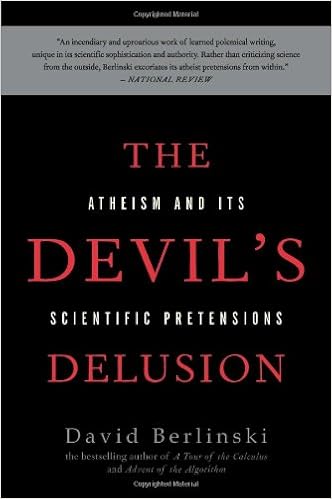
I am reading a book:

The Devil's Delusion: Atheism and its Scientific Pretensions


by David Berlinski


Very, very good.  The ironies and the occasional and very funny sarcasm are so well perceived and communicated, you must cheer for the man.  I will actually read the book twice, I think--something I never do--and underline afterward. 

Also see this video of an event "Socrates in the City" with Berlinsy and Metaxas. 


Wednesday, January 20, 2016

The New Atheism Examined

Some true words are spoken here.  I have experienced some of it first-hand, I would say.

http://www.examiner.com/article/atheists-becoming-disillusioned-with-the-new-atheism

There are two hallmarks of the New Atheism which have been there from the start: a rigid commitment to the advancement of scientific rationalism to stamp out any vestiges of primitive superstitious thought and the establishment of a secular agenda. Not merely the “separation of church and state,” but the total isolation of the church from any aspect of the state: hence campaigns to remove plaques with the Ten Commandments from various courthouses, to disallow nativity scenes in public locations during Christmas, to have the phrase “In God We Trust” removed from United States currency, etc.
Of course, laudable or not, religion isn’t just so much garbage occupying the veranda of American soil. It has classically served a function in society, and as it is tidily swept away to the corners, something must rush in to fill the vacuum left in its wake. When one surveys any classic moment of American history, whether it be the Declaration of Independence, the Gettysburg Address, Dr. Martin Luther King’s famous speech or the words uttered at the moon landing, people have traditionally grounded values in references to God.

...

Another persistent trend within the New Atheist movement is the threatening treatment that women within that movement have received. In his devastating 2014 expose, “Will Misogyny Bring Down the Atheist Movement,” Mark Oppenheimer details a vast undercurrent of misogynistic behavior present within the mainstream Atheist movement, including the worst kind of chauvinism at Skeptic conferences and cyber-bullying of women and feminists; all of this while the movement, as a whole, pays lip-service to the absolute sanctity of women’s rights. Understandably, as Oppenheimer points out, this has pushed many women away:
“For the past several years, Twitter, Facebook, Reddit, and online forums have become hostile places for women who identify as feminists or express concern about widely circulated tales of sexism in the movement. Some women say they are now harassed or mocked at conventions, and the online attacks — which include Jew-baiting, threats of anal rape, and other pleasantries — are so vicious that two activists I spoke with have been diagnosed with post-traumatic stress disorder.”
But perhaps the complaint that has the most considerate of atheists distancing themselves from the movement is that New Atheism tends to caricature and blindly attack that which it designates as a target without any attempt to understand or interact with the ideas. This torch-and-pitchfork waving tendency has a fundamentalist – almost religious – zeal to it which is exactly what these thinkers were attempting to escape in the first place.

Monday, October 5, 2015

The fear of the word "flock"/ Hitchens

In watching the video of Christopher Hitchens' last public appearance, before his anticipated death of cancer, with Richard Dawkins (I don't know why I watch all that stuff), I noted his emphasis on the horror of the word "flock".  Being in a "flock" is the worst part of being "religious", he said with a shudder.  He and Dawkins and other people present were "free thinkers", in contrast, that is they are rational beings.  Which I guess makes all the rest of us irrational beings.

I am afraid that the whole affair looked terribly self-congratulatory.  Dawkins praised Hitchens as the most learned of all men he has met, (and he has met many learned men, since he lives in Oxford) --Someone who can quote and adduce references, at lightening speed.  They called each other brothers and sisters and hugged.  Hitchens had trouble speaking and cut himself somewhat short, not wanting to stand between the assembled and their refreshments, the bar and entertainments.

They looked like quite a "flock" to me, birds of a feather all flocked together. The congregation of free-thinkers, in convention, praising themselves.  Sort of the same as other flocks, only prouder. 


Something else, in this connection:  http://rationalwiki.org/wiki/Sophisticated_theology

From a Facebook friend:  Atheists celebrating their own ignorance.


Tuesday, July 28, 2015

Summer cont.

The summer is lovely.  We have had a lot of rain showers, now, and all the world looks like a paradise of green with flowers, leaves and growing vegetables, in my town.  In nearby areas, however, the harvest is already declared a disaster because of the delay of the rains...

We cycle and walk and check over our plants.  The zucchini has begun delivering the expected oversupply.

The grandbaby is in the third trimester.  God bless it, and its mom and dad. So things about his or her arrival are getting serious.  I finished the blanket I was working on and have decided the next blanket will be of a more simple design.  I am favoring the Old Shale stitch, for next time where counting is needed in only one of the four repeating rows.  It should knit up more quickly with a similar scalloping effect.

I finished several books and watched a few videos, mostly on Gnosticism and related heresies of old.  This really clears up some things but also confuses others.  The deeper you dig, the more into a hole you get.  Time to climb out of it, almost.  I feel  like first I want to write about what Luther has to say about the "devil" and what we meet in the marketplace of ideas, these days.

Yesterday, CBC news informed us that the Satanic statue was finally unveiled in an industrial area of Detroit.  --What an ugly thing it is.  It makes you wonder what would drive someone to go to this sort of imagery.  And the poor little children are worshiping this beast.  In any case, I can't see how this would increase Satanism's appeal.  The "Friendly Atheist" wrote about the poor Satanists and how they had to defend themselves against Christians to stage their event.  Everyone had to sign over their soul to the devil.  Seriously.  On paper.   At least, that kept the protesters away, was the reasoning.  OK.  Obviously, we will blame whom ever we will.  You might have thought that the Friendly Atheists is equally opposed to the statue.  But consistency is no longer considered logical or a virtue.  What a world we have come to live in.  These are the "reasonable" people.

I am finding that knitting is a great antidote to all this stress.  More people should get into it.  It could solve a lot of problems.  Knitting and singing.

See the Old Shale:  Knit a row, purl a row, counting row, knit a row.  /  The counting row is:  knit two together three times, yarn over, knit one, six times, knit two together three times.  (In the flat not round.)

Isn't it the perfect blanket stitch for a baby blanket?  I met a little baby boy who had one, the other day.  His name is Axel.  His blanket was in blue tones.

Old Shale Stitch


Wednesday, June 24, 2015

Summer Books / "The Truth Behind the New Atheism"

Ok, we see that the Ukulele is great, cheap, wholesome and simple fun.  I have learned some new songs and a variety of styles--more simple fun.

Let's get back to some of the books.  There is one that I have begun:
"The Truth Behind the New Atheism", by David Marshall.


I have only read it in little bits and can't say much about it as a whole, at this point.  There are, however, cogent points along the way.

It seems to me that we bump into something called Gnosticism quite often, only that it likes to be a hidden system, though not actually very systematic, and is therefore somewhat slippery and hard to grasp or identify.  Certainly, no one comes right out to say:  I believe such and such because I am a Gnostic.

But that does not make it any less real.  I am getting to have a Gnostic--radar and think maybe I should read more about what it is.

I will quote a bit from page 105-107.  Marshall takes apart Richard Dawkins's claim that the Bible teaches caring only for your in-group.

"Jesus limited his in-group of the saved strictly to Jews,"  says Dawkins. "Sam Harris says the New Testament was written by people who hated Jews.  Hartung and Dawkins say Jesus hated Gentiles."... "Here New Atheists part company even with radical New Testament scholarship, not to mention anyone who has ever read the Book with an open mind!  Even skeptical Bible scholars say the most consistent theme not just in Jesus' teachings, but in his actions, was to tear down barriers between people.  Robert Funk, founder of the radical Jesus seminar, noted that all through the gospels, Jesus "privileged" the poor, sick, infirm, women, children, tax collectors and foreigners.  Liberal colleagues such as Marcus Borg, John Crossan, and Walter Wink underline this point repeatedly.  "In a society ordered by a purity system, the inclusiveness of Jesus' movement embodies a radically alternative social vision." ...Ironically, Dawkins hones in on the phrase "love their neighbor" to illustrate his belief that Jesus only cared about the "in-group". But there was a particular moment in history when "neighbor" emphatically stopped meaning "another Jew" and came forever to mean "anyone you meet."  Dawkins should recognize that moment, for he twice uses the term Good Samaritan."  (Marshall, p. 107)

Quote Marshall, p. 108.

A Samaritan was not a Jew.  He was a despised half-breed.  He was an improbable hero for a rabbi in an era when the always nationalistic Jews were chafing under foreign occupation.  That is precisely, Funk points out, what made the Good Samaritan so typical a hero in a story by Jesus.  The sheer absurdity of accusing Jesus, of all people, of "exclusiveness"  seems almost inspired (by whom, I leave the reader to consider). 

How did we really discover our common humanity?

Aristotle held that "from the hour of their birth, some are marked out for subjection, others for rule."  He even claimed it was better for the "lower sort" to be ruled by masters, since they were "by nature slaves."  Gnostics said some were naturally incapable of being saved from this "lowest region of all matter."  According to the Rig Veda, the four great castes proceed from the mouth, arms, thighs, and feet of Brahma.

With a few kindly allies such a Confuscius, the bible taught us racial unity.  It has always been a theistic dogma that humans are alike in nature and dignity as the image of God.  In one of the earliest Old Testament documents, Job said, "  If I have denied justice to my menservats and maidservants... what will I do when God confronts me?...did not he who made me in the womb make them?"  (Job 31:13-15)  Paul wrote, "There is neither Jew nor Greek, there is neither slave nor free, there is neither male nor female;  for you are all one in Christ Jesus" (Galatians 3:28).  Augustine thus rebutted Aristotle:  Whatever society may do to us, no one is a slave by nature.  There was a great future in that insight.  but there was also a great future in the response by social Darwinist Hermann Klaatch:  "The humanitarian nonsense which grants equal rights to all on the premise of the unity of humanity, is to be condemned from the scientific standpoint." 

---------------  end of quote

This is also interesting from the point of view of the Reformation, where a great popular movement brought literacy and biblical teaching to the masses, wresting it from a priestly class, that had gone quite corrupt.  Also, it was noted quite clearly that there needed to be a shift from Aristotle to Augustine, which I sometimes wonder what that could all mean. Here is one aspect of this shift. 

We hear often, however, even in Luther that people should stay in their callings.  What he means, though, is not that some should be serves and some Lord, but that each should faithfully do his work, since each has his own load to carry.  We need not aspire to all be in a spiritual class, but we serve God in our vocations, as husband, wife, child, student, king, soldier, farmer, pastor, etc.  These are all ennobled by the blessings and callings of God.  This teaching is quite contrary to those who see in the daily affairs a kind of bane that we need to escape.   

We see also how some rationalize their tendency to cruelty, pride and unjust behavior. 


Tuesday, May 20, 2014

"Atheist Temples"


Chesterton would say that atheism and amorality don't build things that are deep or truly beautiful and artistic.

I've hung around some atheistic people.  It can start out nice but it tends to degenerate into insult or debauchery. Even what goes as rational dialogue soon goes south into ad hominems and other fallacies--or straight lies.  They manage to rationalize the rudeness as being necessary to the "process".  "Process" being the holy grail.  But they are the "rational" people--with many books;  so they say.

If there is some beautiful atheist temple somewhere, we'd like to see it.

"MiÅ‚osz's 1953 book, The Captive Mind, is a study about how intellectuals behave under a repressive regime. MiÅ‚osz observed that those who became dissidents were not necessarily those with the strongest minds, but rather those with the weakest stomachs; the mind can rationalize anything, he said, but the stomach can take only so much."


Monday, January 6, 2014

Can Atheism be unified?

http://www.patheos.com/blogs/geneveith/2014/01/schism-in-the-atheist-church-already/

http://gawker.com/5818993/richard-dawkins-torn-limb-from-limbby-atheists


It reminds one of when Hitler was pitted against Stalin, both of whom steam-rolled over millions, not caring how many died.  Can atheism be "friendly"?  Can it be an "assembly"?

Wednesday, October 30, 2013

Logic


Chesterton was a uniquely logical man.  

I've lately met people who claim such universal love for mankind that they hate all religions, even though people are all religious one way or another. 


On the other hand, logic only does so much good.


Since in the Holy Scriptures Christ is called a mystery upon which all heretics dash their heads, we admonish all Christians not to arrogantly indulge their reason in crafty investigations about such mysteries.  With the beloved apostles, they should simply believe.  They should close the eyes of their reason and bring their understanding into captivity to the obedience of Christ, and rejoice without ceasing in the fact that our flesh and blood is placed so high at the right hand of God's majesty and almighty power.  In this way we will certainly find constant consolation in every difficulty and remain well guarded against deadly error.


~BOC, FSD, VIII, 96


Monday, September 23, 2013

Panels of Atheists

I sat up and watched
Richard Dawkins, Daniel Dennett, Sam Harris Ayaan Hirsi Ali in an hour's worth of panel discussion.

http://www.youtube.com/watch?v=JsDt5Ub5JLM

I enjoyed it because some interesting points were made, especially about Islam and the internet--but now it's too late in the day to write about it.  If you watch it, I think you will find it worth and hour's time spent.

What is astounding, always, is the hubris that has confessing atheists continually claiming that they are the only people who think rationally and freely.  Really, they are dogmatists of another sort, which they will never admit.  BUT they have a good vocabulary.

And sometimes they have some good points, such as:  does the wafer turn into Christ's body, as per Roman Catholicism. -- Obviously the bread is still bread, chemically speaking.  Even Luther proclaimed this five hundred years ago, before Chemistry.  So we don't really need Richard Dawkins for this enlightening tidbit.  (He just thinks that slime turns into DNA somehow.  I don't know about you Richard.  I think we should question your sanity, too.)

Sam Harris closing with the wistful thought "what will I do with the Santa Claus shaped hole in my life?"  Was somewhat ironic.  Only barely would they acknowledge that human life is about something more beyond "science".

Friday, August 23, 2013

Introductory comments in the African American Heritage Hymnal


A Rev. Otis Moss, Jr. writes in the introduction to the African American Heritage Hymnal:

     The African-American generation of the 1950s and 1960s beginning in 1955, took the songs and hymns of our ancestors into our marches, jail cell, and mass meetings and fashioned the faith of a movement that reintroduced the African drum, chant, and music in an undisguised and transforming symphony of protest and revolution.
     I remember being arrested and taken to a crowded jail in Atlanta and hearing a welcome song echoing from another section of the jail, "Ain't gonna let nobody turn me 'round." I remember another occasion when the jailer called the Reverend A.D. King and myself  aside for a private conversation.  At first, we were a little suspicious.  but when he began to tell us how he did not want his "soul to be lost," we knew that the spirituality of our movement was akin to that of Paul, Silas, and John.  The jailer was carrying side arms with the authority to kill.  We were armed with righteousness and the power to heal.  The music of the movement did not create this power but communicated it and motivated the messengers, teachers, and leaders.  

J. Alfred Smith, also says:

     During the period from 1960 to the present, gospel choirs have appeared on college campuses.  Members of many of these choirs are atheistic, agnostic, Jewish, or otherwise non-Christian in their faith posture.  They have chosen to sing about God, Jesus, the Holy Spirit, and the providence of God, not for the sake of worship, praise, and adoration of God, but for the motivation of satisfying their own emotional needs or for the embracing of aesthetic appreciation for a musical-cultural art form.  The intentionality of African American musicians in the black church ecumenical family has always been to creatively express, with the community engaged in worship, the deepest feelings of love for and dependence on the God who has come to us in Jesus Christ.
     May the love of God, the grace of the Lord Jesus Christ, and the sweet communion of the Holy Spirit be ever present as you utilize the resources of the hymnal. 

James Abbington made an important distinction between "spirituals" and "gospel songs".  We see here in Smith's comment that "gospel" has also been used to communicate messages of non-Christ-centered material.  I have encountered this in two music workshops now, where all the hymns had been depleted of all biblical references except for possibly a "Hosanna" or "Alleluia" somewhere.  I must say that many of them were quite beautiful songs about social gospel, freedom and such.  But we need to heed this reminder, that a true Gospel song will be grounded in the "dependence on God who has come to us in Jesus Christ."  We are not there to "satisfy emotional needs or embracing aesthetic appreciation" for their own sake.


Product Details


Wednesday, August 21, 2013

Religion for Atheists

When I was a Chapters last week and did not buy Reza Aslan's book, I did chose a different book.  It is titled:  "Religion for Atheists. A Non-believers guide to the uses of Religion."  by Alain De Botton, an author I had not heard of before but who seems very talented to me.


I haven't previously thought about the cover picture which looks like an image of an eclipse. This choice leaves me stumped, at the moment. The book contains many moving images which fit the text in an evocative and meaningful way; but the eclipse--hm. ?  Maybe it means:  there must be some bigger truth out there but we can't grasp it through our religions, even though they are headed in the right direction.  Could be.

I enjoyed the book because it has much insight into human nature.  It is mostly trying to show how much sense religions make in terms of their practices and how they support human life, thought, art, travel, and emotional stability.  His underlying premise, though, I cannot fathom.  For some reason, he expects that all these benefits could be reaped without actually believing anything to be actually true.  This point of view seems to be rampant out there on the internet and in the English department ivory towers.  I haven't actually met any live honest-to-goodness down-to-earth people who hold this sort of ambivalence about truth, unless they are trying to cover something up.

So, you would think that I would be upset with the De Botton.  But he wrote such a fine and gentle and sensible book that I am really very pleased with him.  There is so much in the book which could help some "angry atheist" to calm down and look at the issues more clearly and from another perspective.  In that sense I read it like a Christian apologetic.  One might think that the reasonable conclusion to the matter is, that if religions have so much to go for them, maybe one of them is true?  And one might think that someone on an actual quest for truth would find some sign posts here.

The book helps me calm down, too, because it does not carry this constant, condescending, strident, insensitive, blaspheming, antagonistic, hateful tone that we are subjected to everywhere it seems.  It also helps me understand my own practice of Christianity better and from a different angle.  He makes points about our culture which ring so true but which are not usually articulated.  I think this is what really makes him stand out to me.  De Botton did speak to my soul and used beautiful words and paragraphs to do it.  He spoke truth.  He might be an arch-skeptic but he seems like a decent man.

I will quote a little bit in the next few days.  But since it is a new book, there won't be much.

Sunday, August 4, 2013

C.S. Lewis and his dialectics teacher Kirkpatrick / 3

     I have said that he was almost wholly logical; but not quite.  He had been a Presbyterian and was now an Atheist.  He spent Sunday, as he spent most of his time on weekdays, working in his garden.  But one curious trait from his Presbyterian youth survived.  He always, on Sundays gardened in a different, and slightly more respectable, suit.  An Ulster Scot may come to disbelieve in God, but not to wear his weekday clothes on the Sabbath.
     Having said that he was an Atheist, I hasten to add that he was a "rationalist" of the old, high and dry ninteenth century type.  For Atheism has come down in the world since those days, and mixed itself with politics and learned to dabble in dirt... At the time when I knew him, the fuel of Kirk's Atheism was chiefly of the anthropological and pessimistic kind.  He was great on The Golden Bough and Schopenhauer.
     The reader will remember that my own Atheism and Pessimism were fully formed before I went to Bookham. What I got there was merely fresh ammunition for the defense of a position already chosen.  (pp. 139,140.  C.S.Lewis. Surprised by Joy. Harcourt. 1955)

On the internet I have met a few atheists and former Christians and they seem to me particularly stressed on Sundays and high holy days.  Some of them need to engage in hightened rhethoric and polemic against religion on those days.  I believe this is how this stress manifests and have come to expect it, though it detracts from my own celebration.  If we said that we pray for them when we recognize this we would put them even into a higher distress and frenzy, so one doesn't quite know what to do.  We will just take it and pray in silence (but do know that we pray for you because we... just have to.  XO).

So dear old Knock wore his different suit on Sundays.  Something in him needed to separate the day and honor it.

Schoperian atheism or pessimism I have read about, but I am not sure he has much to tell me that I need to know.  I already know that my own will is pretty bad.  The Golden Bough I haven't read either.  Maybe I will read a summary.

The Golden Bough attempts to define the shared elements of religious belief to scientific thought, discussing fertility rites, human sacrifice, the dying god, the scapegoat and many other symbols and practices whose influence has extended into twentieth-century culture.[2] Its thesis is that old religions were fertility cults that revolved around the worship and periodic sacrifice of a sacred king. Frazer proposed that mankind progresses from magic through religious belief to scientific thought.

Aha.  That sounds like some people.  I might have to peruse it some time.

Alright, then C.S. Lewis describes the day of study, reading, discussion and basic seclusion at the Kirkpatrick house and makes a little point about selfishness and self-centeredness, which is interesting but a little cryptic here.  He does pick up the theme in other places such as the Screwtape Letters.


Such is my ideal, and such then (almost) was the reality of "settled, calm, epicurean life."  It is no doubt for my own good that I have been so generally prevented fro leading it, for it is a life almost entirely selfish.  Selfish, not self centered;  for in such a life my mind would be directed toward a thousand things, not one of which is myself.  the distinction is not unimportant   One of the happiest men and most pleasing companions I have ever known was intensely selfish.  On the other hand I have known people capable of real sacrifice whose lives were nevertheless a misery to themselves and to others, because self-concern and self-pity filled all their thoughts.  Either condition will destroy the soul in the end.  But till the end, give me the man who takes the best of everything (even at my expense) and then talks of other things rather than the man who serves me and talks of himself, and whose very kindnesses are a continual reproach, a continual demand for pity, gratitude, and admiration.

Ya.  

We know about these things.  The Lord preserve us from them in others and ourselves.  It is the great trial to deal with the ego and that of others. 

Kirkpatrick's ego one could stand to hear a bit more about, but Lewis leaves it at that.  It seems Kirkpatrick was a reclusive man who thought, as we heard, even the bridge ladies wanted to define terms for hours on end.  Is that what Lewis meant:  a man wholly absorbed in his own thoughts and own way of thinking to his own pleasure?


Monday, July 29, 2013

"Angry Atheists" / C.S.Lewis and Rex Murphy

In "Surprised by Joy" we hear about Lewis' faith or lack of faith state while at Wyvern Public School.


"I was at this time living, like so many Atheists or Antitheists, in a whirl of contradictions.  I maintained that God did not exist.  I was also very angry with God for not existing.  I was equally angry with Him for creating a world." (p. 115, Harvest Books, 1955)

When you go out on the internet as a confessing Christian and meet your first set of hard-boiled atheists, you notice at once the fierce anger, the immediate insults though you have barely said a thing to them.  In the beginning it strikes you as strange and ill, but by now it is a pattern.  

Does it stem from this "whirl of contradictions" in the soul?  Oh, sure, you can always find fault with religion, politics, culture, etc., but what is it really?  

Rex Murphy, a respected Canadian commentator, dissected the atheist mind-set and method and ferreted out a number of contradictions.  Here is the article.  It is a must read.  
http://fullcomment.nationalpost.com/2013/07/27/rex-murphy-the-angry-athiest/

He begins by highlighting the "unmanly" attack of Christopher Hitchens on Mother Theresa.  This seems to be a prime example of this "anger". 

Then he goes on to Richard Dawkins, Hichtchens' "grim, self-advertising equal". "Dawkins can be quite the toad, a kind of Don Rickles for unbelievers.  He appears not so much as a person who subscribes to a particular philosophy or worldview as someone who cannot abide the thought that others do not wish to think the same as he. There’s something almost fanatic about the intensity with which he derides and insults Christians and other faiths (but, it seems to me, mostly Christians)."

Then Rex has a brief look at the atheist "victim" mentality.  They deride religion vociferously and then complain that everywhere they look they are subjected to being reminded of it.  Then they complain about creches and such things.  "A strange posture" says Rex.

Then they complain that their "human rights" are infringed upon by having to witness such things.  What has this to do with "human rights"?   "Actually, of course, the comforts of religion, for believers, are not “human” rights at all, but the mercies of a benevolent God. Thankfully, these fall outside the reach of any tribunal to grant or grieve."  

So, whatever they derive from atheism should not be a matter of tribunals but of intrinsic value.   What substantial thing are you getting from atheism?  Do you really need to keep resorting to courts?

From here, Rex, launches into the very strange demand by atheists in the U.S. military for their own chaplain.  Why would an atheist need a chaplain?  "Very odd, to say the least. But, as usual, the professional non-believers see themselves as much put-upon and ignored. They claim, in fact, to be (within the Army) more numerous than 'Jews or Hindus or Buddhists or Muslims.'  It’s very telling they make this comparison, for here, as in much else of modern atheism, they betray the need to be seen in the very category of those they derogate: a religious one. Why should those who don’t believe at all clamour for the same structures, assists and services of those who in fact do believe? Funny, you never hear them wishing for their own Hell."

It is a contradiction that the very ones seeing themselves as atheists put themselves into in this kind of category.  

To bring the whole argument to a nice climatic conclusion Rex drives the argument to its end:  "After all, to chase the religious analogy to its limit, then they should equally be asking for prayer, the remission of sins, occasional fasts and Lenten exercises, and at least Sabbath and Sunday services. At which, under clouds of incense, they could intone from the works of George Orwell and Thomas Huxley and chant a hymn: Our Dawk, who art in the Guardian, and always on the BBC, hollowed be thy fame, thy royalties come, thy shill be done … “

The whole thing is "ludicrous", says he.

It does say something about our souls.  Atheism is indeed deeply contradictory, at least for many, as it was for C.S.Lewis.  And it does not work.  It does not work on an inter-personal level, nor an intra-soul level.  We are just not made this way. 

Monday, July 1, 2013

Atheist Monument Exposed For All to See in Florida

An atheist believes that a hospital should be built instead of a church. An atheist believes that a deed must be done instead of a prayer said. An atheist strives for involvement in life and not escape into death. He wants disease conquered, poverty banished, war eliminated."


The Atheist Monument in Florida:

proclaims 
--that a hospital should be built instead of a church.  Who has built the hospitals? The universities? All that "institutional" stuff everyone despises these days. 
--or how about instead of a "mosque", an "ashram", a "drop-in-center", a "community hall";  why "church"?
--Since when does a prayer preclude a deed?  ANY THING that needs to be DONE, needs to be contemplated first.  More thoughtfulness and more prayerfulness would do us all a TON of good.  How I wish I were more prayerful.  I am trying to be more prayerful.  It really is a good life goal.  There are way too many deeds and not enough thinking.   Only in an emergency is it advisable to rush and do without much thinking and praying. 
--atheists strive for involvement with "life"? How about they build some hospitals and then they can perform the abortions and euthanasia in them and leave the poor Catholics and others alone?
--He (or must include "she", where is "she") wants disease conquered, poverty banished and war eliminated--Who for crying out loud does not want that?  And how is the atheist going to go about achieving this?  What is he going to do?

This is too inane for words.  All this fuss for this ridiculous bench.  It is hardy fathomable.  They should have put their money in a hospital that promotes life not death. 

I am finding that the news regarding this Florida monument deals much more with the uproar involved than the actual content of any words.  But with this kind of monument, as dumb as the inscription is, I am not too surprised that the pictures of the thing seem to be blurred and and the words hardly readable.   You want to put that alongside the 10 commandments and someone is going to find this wholesome, thoughtful and inspiring by comparison?  (That is a rhethorical question.) 

Wednesday, June 19, 2013

Post-Christian Apologists

Driving home, yesterday, I listened to an interview with an ex-Pentecostal preacher from the American religious south.  He said about 60% of the people there are Pentecostal and 30% of the people are Baptist, and the remaining 10% are everything else.  He was from the backwoods of Louisiana, where towns and cities are called "parishes", to this day.  I forget his name and his book's title.   Jeff was the first name.

Well, if I had grown up Pentecostal, I don't quite know what I'd have to say today.  I have heard Pentecostal preachers and have not believed a word they said. They have always struck me as charlatans.  The man said that he got a high out of preaching and moving the people and himself into a sort of frenzy or emotional experience.  This is the very thing which my denomination is not trying to do, dubbing itself the "frozen chosen", in self-reproach.  But in fact, there is a deep and meaningful emotional experience that is not frenzy- like or brain dead, which some people don't seem to get. But, be that as it may.  Our ex-preacher, now is somehow connected to a clergy project, which who knows what that is or is aiming for exactly, seems to need to "out" all those disaffected with their churches, and making great, big announcement and splashes about their fall from faith, and then make more splashes about those who may be angered by what they do and say.

So in the end, they may say and critique whatever they like but no one can critique them, because that is unfair.  I have observed this a few times now.  And though I've never read Ann Coulter, I have come across this snippet of hers:  "A liberal is someone who has one set of rules for himself and another set of rules for everyone else."  This seems to be the corollary to the consciousness raising they need to effect in other people.  In the name of love, and mental development and all sorts of worthy causes, they may now be unloving, anti-intellectual, rude, accusing, etc.  In the name of getting rid of other people's biases and idiocy, they may use any means (while decrying theirs).

Anyhow, ex-preacher is now on book and speaking tour, getting interviews on our beloved CBC, and so on.  All the while this, as the world is burning and millions are persecuted for their faith all around the world.  While the Middle-East is loosing its ancient, indigenous remaining Christian population.  While churches are bombed and bull-dozed and worshipers attacked.   While all that, we need to hear about in-your-face-ex-Pentecostal's emotional woes.  I am not saying that we don't need to hear his point of view, but it seems that there is a concerted effort to unleash a horde of these kinds of critics.  It's whoever the media makes out to be the victim.

---------------

While driving around this morning, this story came up again with some letters of feedback read.
Here is a link to the interview.  We see that commenting is closed.  The interview was with Jerry DeWitt on CBC with  Jian Ghomeshi.  As some people said:  why is this story on my public broadcaster?  


Friday, December 14, 2012

Brahms / Dump the Myth

I'm still a little obsessed with Johannes Brahms.

I listened to a series on his symphonies on CBC radio, where the host was in conversation with Pinchas Zukerman, famous conductor.  At one point they mused that the reason Brahms never wrote an opera was because he might have been too religious.  This swayed me for a moment.  Brahms wrote the requiem and people thought him "religious."  ?  Nope.  I think we had it right in the last post.  Art was indeed his religion and Christianity goes as sterile and what not, a la Wagner. We have this analyzed somewhat clearly in this article by the Freethinkers:   http://ffrf.org/legacy/fttoday/2002/may02/barker.php   Brahms would have gladly called his German Requiem, the human or humanist requiem.

His art is indeed most touching and moving.  And EVEN the requiem, I can barely get over it, it is so beautiful -- it is anti-Christian.  I think I am going to cry.

He takes all the meaningful moments, anything with some gravitas, and throws out the "myth".  I am alluding to the advertisement that atheist have put up in Time Square, this Christmas:  Keep the MERRY!  Dump the MYTH!

american atheists christmas billboard


This sort of thing--we are almost getting used to, though even the popular media deems a despicable hit below the belt.  Here we want to keep the "merry" and throw out the "myth".

Brahms kept the "gravitas" and threw out the "myth".  It really is analogous.

None want the Savior who died for them to forgive their sins and they will have their choice.  There will be no Savior.

I don't understand them, though.  What are all the whipped up feelings, the merriment, or the depth, or even eroticism and all the things people are after.  How long does any of it satisfy?  Is your soul not responding when it hears God's word, and you realize that you too are a sinner.  Where is your self-knowledge?  Where is this genuine crying need for a Savior?  What happened to your soul?  --  Sensitivity, art, ect. have become your soul.  You cultivate it.  You contradict things didactic and historic as simply too banal for your tastes.  The cross, the one thing that is not a myth, becomes the thing to be discarded.  What a turning everything on its head.


Wednesday, March 21, 2012

Some points from Alister McGrath's "The Dawkins Delusion. Atheist Fundamentalism and the Denial of the Divine."

I will be picking out several quotes to do with surveys about how many scientist consider themselves atheists, the relationship between faith and science, and questions of meaning and purpose.

Here is a link to Alister McGrath's book "The Dawkins Delusion".

There is available also a video dialogue between McGrath and Dawkins here, in 15 short segments.


Quote:

I have often wondered how Dawkins and I could draw such totally different conclusions on the basis of reflecting long and hard on substantially the same world.  One possibility might be that, because I believe in God, I am deranged, deluded, deceived and deceiving, my intellectual capacity having been warped through having been hijacked by an infections, malignant God virus, I believe in God.  Both those, I fear, are the substance of the answer I find in the pages of The God Delusion.


This may be an answer, but it's not particularly a persuasive answer.  It might appeal to die-hard atheists whose unbending faith does not permit them to operate outside the "non-God" box.  But I hope that I am right in suggesting that such nonthinking dogmatists are not typical of atheism.  Another answer to my question might be to repeat the same nonsense, this time applying it to Dawkins.  (Although in this case, I suppose that we would have to posit that his mind had been hijacked by some kind of "no-god virus.")  But I have no intention of writing something so implausible.  Why insult Dawkins?  Even more important, why insult the intelligence of my readers?


The beginnings of a real answer like in some wise words of Stephen Jay Gould, whose sad death from cancer in 2002 robbed Harvard University of one of its most stimulating teachers, and a popular scientific readership of one of its most accessible writers.  Though an atheist, Gould was absolutely clear that the natural sciences--including evolutionary theory--were consistent with both atheism and conventional religious belief.  Unless half his scientific colleagues were total fools--a presumption that Gould rightly dismissed as nonsense, whichever half it is applied to--there could be not other responsible way of making sense of the varied responses to reality on the part of the intelligent, informed people that he knew.  


This is not the quick and easy answer that many would like.  But it may well be right--or at least point in the right direction.  It helps us understand why such people hold such fundamentally different believers on these matters--and why some others consequently believe that, in the end, these questions cannot be answered with confidence.  And it reminds us of the need to treat those who disagree with us on such questions with complete intellectual respect rather than dismissing them as liars, knaves and charlatans.


Whereas Gould at least tries to weigh the evidence, Dawkins simply offers the atheist equivalent of slick hellfire preaching, substituting turbocharged rhetoric and highly selective manipulation of facts for careful, evidence-based thinking.  Curiously, there is surprisingly little scientific analysis in The God Delusion.  There's a lot of pseudo-scientific speculation, linked with wider cultural criticisms of religion, mostly borrowed from older atheist writings.  Dawkins preaches to his god-hating choirs, who are clearly expected to relish his rhetorical salvoes and raise their hand high in adulation.  Those who think biological evolution can be reconciled with religion are dishonest!  Amen!  they belong to the "Neville Chamberlain school" of evolutionists?  They are appeasers!  Amen!  Real scientists reject belief in God!  Hallelujah!  The God that Jews believed in back in Old Testament times is a psychotic child abuser!  Amen!  You tell them, brother!


When I read The God Delusion  I was both saddened and troubled.  How, I wondered, could such a gifted popularizer of the natural sciences, who once had such a passionate concern for the objective analysis of evidence, turn into such an aggressive antireligous propagandist with an apparent disregard for evidence that was not favorable to his case?  Why were the natural sciences being so abused in an attempt to advance atheist fundamentalism?  I have no adequate explanation.  Like so many of my atheist friends, I simply cannot understand the astonishing hostility that he displays toward religion.  Religion to Dawkins is like a red flag to a bull--evoking not merely an aggressive response but one that throw normal scholarly conventions about scrupulous accuracy and fairness to the winds.  While his book is written with rhetorical passion and power, the stridency of its assertions merely masks tired, weak and recycled arguments.


I am not alone in feeling disappointed here.  The God Delusion trumpets the fact that is author was recently voted one of the world's three leading intellectuals.  This survey took place among the readers of Prospect magazine in November 2005.  So what did this same magazine make of Dawkins's book?  Its reviewer was shocked at this "incurious, dogmatic, rambling, and self-contradictory" book.  The title of the review?  "Dawkins the Dogmatist." (pp. 10-12)


End of this quote from the Introduction.


Quote 


Underlying the agenda of The God Delusion is a pervasive belief that science has disproved God.  Those who continue to believe in God are simply obscurantist, superstitious reactionaries, who are in complete denial about the victorious advance of the sciences, which have eliminated God from even the most minuscule gaps in our understanding of the universe.  Atheism is the only option for the serious progressive, thinking person. 


But it's not that simple--and just about every natural scientist that I have talked to about this issue knows this.  We have already noted Stephen Jay Gould's rejection of any brash equation of scientific excellence with an atheist faith.  As Gould observed in Rocks of Ages, based on the religious views of leading evolutionary biologists:  "Either half my colleagues are enormously stupid, or else the science of Darwinism is fully compatible with conventional religious beliefs--and equally compatible with atheism." As I pointed out in Dawkins' God, his point is fair and widely accepted:  nature can be interpreted in a theistic or in an atheistic way--but it demands neither of these.  Both are genuine intellectual possibilities for science.


The fact that America's leading evolutionary biologist would make such a statement outrages Dawkins.  How could he say such a thing!  Dawkins dismisses Gould's thought without giving them serious consideration.  "I simply do not believe that Gould could possibly have meant much of what he wrote in Rocks of Ages."  This creedal statement is Dawkins' substitute for a response.  It simply will not do.  For Gould has simply articulated the widely held view that there are limits to science.  The same view, much to Dawkins's irritation, is found in Martin Rees's admirable Cosmic Habitat, which (entirely reasonably) points out that some ultimate questions "lie beyond science."  As Rees is the president of the Royal Society, which brings together Britain's leading scientists, his comments deserve careful and critical attention.  


The fundamental issue confronting the sciences is how to make sense of a highly complex, multifaceted, multilayered reality.  This fundamental question in human knowledge has been much discussed by philosophers of science, and often ignored by those who, for their own reasons, want to portray science as the only viable route to genuine knowledge.   Above all, it pulls the rug out from under those who want to talk simplistically about scientific "proof" or "disproof" of such things as the meaning of life or the existence of 
God.  The natural sciences depend on inductive inference, which is a matter of "weighing evidence and judging probability, not of proof."  Competing explanations are evident at every level of the human endeavor to represent the world--from the details of quantum mechanics to what Karl Popper termed "ultimate questions" of meaning.


This means that the great questions of life (some of which are also scientific questions) cannot be answered with any degree of certainty.  Any given set of observations can be explained by a number of theories.  To use the jargon of the philosophy of science:  theories are underdetermined by the evidence.  They questions then arises:  what criteria ca be used to decide between them, especially when they are "empirically equivalent"?  Simplicity?  Beauty?  The debate rages, unresolved.  And its outcome is entirely to be expected:  the great questions remain unanswered.  There can be no question of scientific "proof" of ultimate questions.  Either we cannot answer them or we must answer them on grounds other than the sciences.  (pp. 33-35, chapter 2)


Quote


In a sophisticated recent critique of the philosophical shallowness of much contemporary scientific writing, particularly in the neurosciences, Max Bennett and Peter Hacker direct particular criticism against the naive "science explains everything" outlook that Dawkins seems determined to advance.  Scientific theories cannot be said to "explain the world"--they only explain the phenomena that are observed within the world.  Furthermore, they argue, scientific theories do not and are not intended to describe and explain "everything about the world"--such as its purpose.  Law, economics and sociology can be cited as examples of disciplines which engage with domain-specific phenomena without in any way having to regard themselves as somehow being inferior to or dependent on the natural sciences.


Yet most important, there are many questions that by their very nature must be recognized to lie beyond the legitimate scope of the scientific method, as this is normally understood.  For example, is there purpose within nature?  Dawkins regards this as a spurious non-question.  Yet this is hardly an illegitimate question for human beings to ask or to hope to have answered.  Bennett and Hacker point out that the natural sciences are not in a position to comment on this if their methods are applied legitimately.  The question  cannot be dismissed as illegitimate or nonsensical;  it is simply being declared to lie beyond the scope of the scientific method.  If it can be answered, it must be answered on other grounds.  (pp. 36-37, chapter 2)