Showing posts with label Books. Show all posts

Thursday, April 11, 2019

The Basic Plots and Middlemarch

The month of March was difficult with influenza going around and, weather-wise, huge mounds of snow melting only very gradually, keeping the air rather cool.  April, so far, has not been much different, except  that it appears that the last patches of snow have now disappeared while the ponds are still frozen over.

The returned Canada geese are looking to make nests, with the ganders marching about protectively, but they are not impressed with having to arrive on ice.  They exhibit an interesting landing maneuver coming in feet first and then getting around like an icebreaker.  They do look well-fattened from where ever they are coming from.  The birds may be a pest in places, but they belong here, and their honking arrival is delightful.  The geese's spirit is harbinger of new life and summer around the corner.  Thank God, he made such large and sturdy, sometimes comical, birds for our climate. 

Meanwhile, I had taken the opportunity to read some huge "honking" books.  One was "Seven Basic Plots.  Why we tell stories."  The author is Christopher Booker.  736 pages.
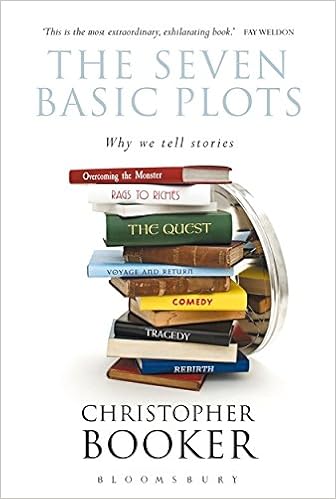


For some time, I wanted to explore the topic of "plots" because story telling does not come to me naturally as a passion or art form. Well, not since about grade 5 or so, when we started learning foreign languages in school and explored other "real" countries and histories in books or through actual travel, as is easily afforded living in Europe.  Before that we made up plays from props in the house or used our puppet theater.  I enjoyed Mr. Booker's book because he broke down the plotting not so much in a dry, technical way but in terms of what is going on with the characters, and that in a sort of archetypal way, making the application universal.  The critics of his book would say that he has put a kind of straight-jacket onto story-telling, discarding all those stories that don't fit the schemes, especially more modern ones, as somehow deficient.  It may seem that Booker would say that story-telling has devolved in some respects.

It really is a tome to reckon with.  Many stories are explored in great detail, resulting in my feeling better equipped to tailor future reading after his analysis. Someone asked me if I felt more ready to write a story after reading this book, and I have to say that I don't think so.  My passion is always to find out what is really going on in a past or current situation, and the idea of storytelling gives me the feeling of artificiality and manipulation.  Someone told me:  "Push through to untruth". -- I don't know.  I want to know how it is EXACTLY.  Does that need to be overcome to be an effective storyteller?  Jesus was a storyteller, but his stories were obvious parables.  Everyone understood that they were brief analogies.  But in a sense Jesus' stories were "manipulation" as he broke the news to people in unexpected ways, having them let down their guard to listen with interest.

Sometimes, though, people leaning to the fiction side of storytelling can't tell the difference anymore between truth and untruth.  So I find that also Booker won't distinguish between the fanciful and the real, at times.  For example, he discusses the use of the unexpected, miraculous weapon that will defeat the enemy.  Here he basically puts side by side James Bond and King David.  James Bond always has a new weapon or vehicle up his sleeve to extricate him from dire circumstances to save himself, the girl and the world.  We seriously get a comparison here from the esteemed Mr. Booker to the ancient King David who killed the giant with a stone and a sling-shot, receiving King Saul's daughter's hand in marriage.  The only difference with the Bible stories are that they go on and on in time and don't have a properly resolved ending.  --Yes, really.

There problem, as I see it, with this is that the literary giants of our times and other times don't believe that Bible stories are "real" stories, that is true stories, in the way that the non-literary person conceives a "true story". We are to see everything under out eyes in an archetypally true way ONLY.  If you don't agree, you are a Philistine to them (in the non-literal way, of course, as if there had never ever really been any Philistines.)

So much for Booker's book.  It is exhaustive and I believe he spent a lifetime, over 30 years, slaying the giant of getting everything under control neatly, even David and Goliath.

The other very large book I enjoyed was George Elliot's "Middlemarch".  It is, of course, a famous novel, written by a woman who needs no introduction.  The volume had sat on my shelf ever since I purchased it in a used bookstore under some mysterious prompting.  It revealed itself to me, just now, and I really, really loved it.  Seriously, I am a fan, all 900 pages of it.  It is superfluous to tell you why it was wonderful, as it such a dearly loved classic.  But I will just say that the novel served to illustrate some of Christopher Booker's points about characters and the arcs of stories. In Dorothea we have a typical lovely female serving as the great prize that needs to wrestled away from the dragon of upper-class snobbery by the unlikely hero in the form of  the honorable but unconventional Ladislaw.  Ladislaw is in effect a writer disguised as a dilettante. We could say that we have again a book written by a writer about a writers.

In Middlemarch, we find another kind of author, the famous Rev. Edward Casaubon, muddled and mired very deeply in his endless research.  Ironically, he vaguely reminds me of the just before-mentioned Mr. Booker, in trying to systematize and unite all types of stories.  Casaubon labored his entire life in the libraries hoping to produce his grand book of  "The Key to all Mythologies."  Like Mr. Booker he may have been overreaching, but nevertheless, we should sympathize with him in his great effort and its attendant result, his early death, as articulated and forever noted, by the great philosopher Solomon (of actual existence):  "Of making many books there is no end, and much study wearies the body."  (Ecclesiastes 12:12) 


Image result for Solomon


Friday, November 2, 2018

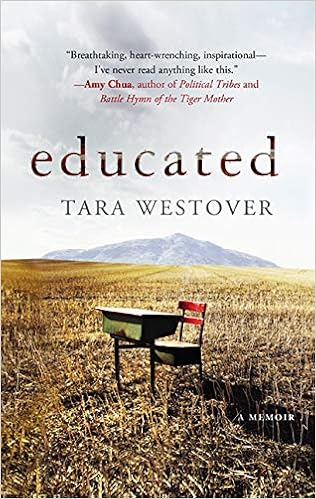
"Educated"

While we were on a road-trip in September, I had an opportunity to read several books.  The first one was "Educated:  A Memoir" by Tara Westover.  I had picked it up at Costco because the reviews on the cover were stellar.  And the book did not disappoint.

Tara Westover tells a realistic, yet stunning story of growing up in Idaho, in a Mormon family who refuses to register its children, refuses to send them to school, refuses to let them see the Doctor.  The father runs a scrap yard among other businesses that involve the children working in dangerous situation.  The mother becomes a midwife so women do not have to see a doctor.  Individuals  inadvertently become subject to various forms of neglect, abuse and child labor, unnecessary accidents, even though the parents are highly idealistic and religious, well-meaning in their own way.  For the child growing up this is insidious, as it knows no different life. Freeing herself from it requires all the strength Tara can muster.  It is complicated, to say the least.

For me, it is a lesson in several areas.  First of all, the depth of commitment to their lifestyle by American cultists.  In many places in the world such isolation is not possible and communities are much better integrated.  In America, however, it is possible, and in any case it is the "land of the cults" as Lutheran immigrant pastor/missionary Walther said. In Lutheran theology, the calling of the Christian person can be to be a medical doctor, a scrap yard owner, a pastor, a midwife, policeman, governor, housewife...  All these callings are God's gifts to a helpful and integrated society. With the cult, however, an alienation is essential to keep the message alive, the message of isolation and individualism.  A message of being different from other people in society.

Not that learning some survival skills would not be a good thing.  Nowadays, we are so disconnected from nature and the way things used to be done even just two generations ago, that it makes us wonder what it is to be truly human without all our helps and technologies.  Certainly, there is a tension inherent, that we can all understand.  I myself was thinking we should get a generator when North Korea was sending missiles over Japan last year.  There is the dirty bomb that could travel very far that disrupt all our communications and electrical grids. I was trying to imagine it, though I am not given to apolitical speculations.  In fact, my generation, and especially myself hailing from the former West Germany, lived in the shadow of the bomb.  How will we be able to survive when everything fails or is destroyed?  Would we even want to try?

Maybe a generator would be good, but then you need fuel...  Most of all, you would need water...

Where does it start and end.  It becomes a paranoia, more than anything.  But emergency preparedness is a sensible thing...

The book also makes me think about our current NDP government in my Canadian province.  They have a left-leaning ideology, which has manifested itself in interesting ways, so interesting that they cannot be elected again.  One of the first things, they have done, was to ram down the throats of farmers all kinds of laws regarding farm labor.  Perhaps, there are concerns I had not considered.  I know a family where all four children died in two separate farm accidents.  The marriage also ended up breaking apart. I know a farm where a toddler was run over.  But that can happen anywhere.  I know a farm where a young man nearly burned himself to death.  But had been very foolish.  I know a farm where a young Mennonite helper was electrocuted just a few weeks into the job.  No doubt, the young are at risk.  But then my own 18-year old died in a car accident.

What factors can be controlled?  In any case, the NDP should have had a consultative, bottom-up process, rather than asserted itself in the way it did, right out of the start gate alienating so many.  From then on, it also went on to alienate Christians of all stripes.  This also, was not ok.  Christians, in general, are not like Tara Westover's father and mother.  Mostly, they live in responsible, well integrated communities.  Some oversight is always a good idea, but government oppression of consciences is not.  They are your average, more or less, good citizen.  And that is what we have had in my province, as of late.  On that level, I had wondered if "Educated" is an anti-Christian book, but that would be not a fair interpretation. Overall, Westover has considered her communication carefully, and her points are well taken.  There are indeed Mormon families hiding in Canadian mountain regions trying to keep polygamous groupings intact.  These things do happen.  And children suffer.  We must support the weaker and younger elements in society.

The most memorable part of the book, however, was the philosophical and literary point of view.  Westover took a degree in history, or more like the philosophy of history, or the process of making history.  In relation to this, she comes to interesting conclusions, which one ought to read for oneself.  What hit me most is that by writing her own autobiography, she says she is "writing history", herself. 

It makes me consider all the autobiographies that have lived in my head and my life, all this time--my grandfather's, expelled from Silesia, my in-law's, fleeing Poland after the war.  Stories that have not made it to the movie screens and histories that have been expunged from the collective memory. These stories make me different from my Canadian neighbors, though many immigrant populations also have suffered through wars, famine, oppression, even persecution.  But the languages and images are different, and these communities tend to stay in their own corners. Currently, public discourse has been deluged with programs dealing with LGTBQ issues, as well as Indigenous affairs.  In some ways, it is not a surprise that we have all fractured into new subgroups of discussion groups and media consumption.  Some are becoming their own islands, their own Idahoes.  We are educating ourselves online and what does this mean?


Wednesday, October 25, 2017

"Lord, keep us steadfast in your Word"

Talking about books...

This fall, I am privileged to spend some time teaching music to families with young children, again.

My husband and I have begun accumulating a little library of books with songs, for young children. There is a book series we enjoy tremendously. The songs are adapted by John M. Feierabend, with very creative artwork from various artists to add illustration and give fodder for discussion with children.

Our little toddler knows each book by the title and knows all the songs.  Every time she comes over, she pulls these books out for Opa to sing to her.  Opa has never had so much fun in his life.  The first one we purchased was "The Tailor and the Mouse."  We love it especially for the tune in Aeolian minor tonality and its bouncy rhythm, all while the poor mouse has to live through several stunning adventures.


Which brings me to a new little children's illustrated song-book from Concordia Publishing House.
I also bought it on Amazon, due to Amazon's efficient way of finding books for me...


LORD, Keep Us Steadfast in Your Word.  is such a wonderful, old Reformation hymn that it is a TREASURE to have it in this format for family use.

Thank you, to Martin Luther for writing the hymn.  Thank you to Karyn Lukasek for her illustrations, and thank you to the Publisher.  This is a great addition to our well-used children's illustrated song book shelf.

Below, also see Grandma's music studio supplies and reachable bookshelves for self-service for little people.


Tuesday, October 24, 2017

Power

On the internet...  I have met people who have considered all matters in the light of "Power" and power-plays.  Generally, I flatter myself with the opinion that I don't have this mindset but seek out the freedom of Christ for every person through the work of the Spirit of God.  We don't have power over each other.  Our relationships are ordered by our relationship to Christ.

One thing that happened to me online was that if you discuss something about the Lutheran Reformation, some thought pops into the thread about how Luther exerted his power by blaming the victims  ("victim-blaming being a great injustice in the world, no doubt, but some like to find victims everywhere through so-called "consciousness-raising" and then we get the favorite victim of the day.) --That person has lost complete sight of how the Reformation freed all sorts of people from dominion that was oppressive and corrupt.

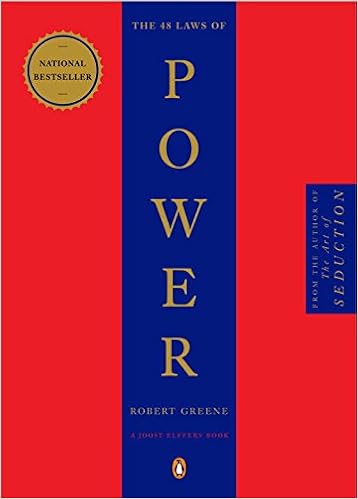
Some of these people on-line mentioned a book, that seemed to a sort of Bible to them,  called "The 48 Laws of Power".  Here it is.


In the end, you guessed it,  I succumbed to the temptation and bought it.  It sat on the shelf for a while, as it is quite a thick and thorough anthology, though broken down into many manageable sections.  Overall, it reminds of Machiavelli's "The Prince".

The introduction explores why a person might be interested in reading this type of book and what  might be gleaned for various purposes.

Lately, I have begun to tackle the book, being at the moment about half through,  by reading a little bit every evening as an aid to going to sleep.  This is not meant to be derogatory, but the heavy stuff, in small bites, as presented, allows the cognition to switch from the troubles of the day to the ideas presented which can be quite knotty but in story format.  There is something for the brain to chew on.  Meanwhile, the body says:  "Enough of all that."  And the eye-lids get so heavy.  It's perfect for that.  After one more story, you decide that you have had it for the day.

As to the contents, as I am chewing on it in bite-sizes, it does furnish nutritious food for thought.  Certainly, it is not the stuff my parents taught me, my teachers taught me, but maybe life has taught me through experience and observation.  There is certainly truth here to be witnessed to.  Some of the anecdotes are even from the Bible.

Literary-wise, the stories are also valuable and engaging reading coming from some great books.  So, while one may not wish to employ the stratagems discussed here, even some Biblical ones, we recall the words of our Lord Christ, who taught us to be as wise as serpents but innocent as doves.  Also, he tells a parable to explain how the world works and manipulates matters to its favor.  In this manner of being wise and observant, we can profitably study a book like the "Laws of Power", I think.  In some ways, I must admit, that at this late date, some coins are dropping in my head, looking back on some decades now...  Still, we pray the Lord preserve us from manipulation and cruelty.


Image result for reading to go to sleep

Friday, November 20, 2015

Trees on Mars. Our Obsession with the Future

http://www.amazon.com/Trees-Mars-Our-Obsession-Future/dp/1609806379

While driving this morning, I listened to a lengthy interview with the author of a new book titled interestingly and memorably "Trees on Mars.  Our Obsession with the Future".


The author spoke incredibly well and I am thinking about getting the book.  It seems it  came out this October, and Amazon has no reviews and ratings, yet.

When I turned on the radio, he was just speaking about "Disruption."  Disruption is a current buzz-word in various places like Universities and technology innovators.  It means something like setting aside all the old, so that the future can be imagined and brought about.  Niedzviecki believes in what makes us human, story-telling and face-to-face contact.  He has no idea why anyone would be on Facebook, for example.  Some technologies don't make sense on the human level.  Of course, he is on Facebook, too, but it does not make sense to him, overall.

He pointed out the absurdities of some of our ambitions, and the goals that are being set before our young people.  For example, a woman from Edmonton was short-listed to go on a mission to Mars, on a one-way ticket.  Her husband did not make the short-list.  On the air, the tape was played:  "Yes, of course, I would miss my husband, but..."  Niedzviecki had some really good words to describe what is going on here, but I forgot them now.  But those would be what the book is about:  showing how we are sacrificing humanity for outlandish and practically useless dreams and ambitions.

No doubt, he might go a little far here and there, but I don't know that the main points should not be well taken.  He says, young people, and many of those "precariously employed",  really just want what their parents had--stable employment, affordable housing, etc.


Friday, May 29, 2015

Note for me: German Comedian

My husband was in Germany and Poland.  Three main impressions have made it into my consciousness so far from his tales.

1.  The German is train system is not what it was before some sort of restructuring or privatizing.  In fact, it was a complete disaster because of strikes, and he lost the used of a pre-paid ticket, with no way to get his money back.

2.  A Polish nun, in the town where a family member was baptized, in a place that was formerly Germany said, that the Polish don't view the area as Polish even in the third generation.  They have lost their land further East, that they pine for, even now. -- It must add to this feeling, that ethnic Germans, from as far away as Canada,  still make pilgrimages to these places, a generation down the line.

3.  In the cities, many black African immigrants are begging in public places.

Well, to make up what I've missed, I binge watched a German comedian last night, on YouTube.  His name is Rainald Grebe.

To make up for it, too, I have ordered a book, written by a poet from Berlin, a non-state-church Lutheran, I know from Facebook.  It is a novel, set in Berlin, at the turn of the millennium, highlighting the lack of direction in society.  It is so brand new and I ordered it so quickly that I will have the first problematic edition:  the title on the spine will run to wrong way, for German books.  This problem is now fixed, but my book has already shipped from Amazon.com.

It is titled "Rain Dogs", but, of course, it is in German language.


I think that there are enough books on the go for the summer, now.  I will keep you posted.


Catch up

My husband was gone on a trip and now he is back.  I had to hold up this end of things by myself in a major way, but I lost weight while he was gone.  No cooking for a man--equals weight-loss--who would have guessed.  Doing all the labor around house--equals weight-loss--who would have guessed.  Having no time for knitting baby blankets equals weight-loss...  Getting hardly any reading done...

No, no, some reading got done, in the last month.   I read all of  "Adventures of Huckleberry Finn."  


Comments tell us that this is a very important work.

"Referring to Adventures of Huckleberry Finn, H. L. Mencken noted that his discovery of this classic American novel was 'the most stupendous event of my whole lif'; Ernest Hemingway declared that 'all modern American literature stems from this one book,' while T. S. Eliot called Huck 'one of the permanent symbolic figures of fiction, not unworthy to take a place with Ulysses, Faust, Don Quixote, Don Juan, Hamlet.'"

"A seminal work of American Literature that still commands deep praise and still elicits controversy, Adventures of Huckleberry Finn is essential to the understanding of the American soul. The recent discovery of the first half of Twain's manuscript, long thought lost, made front-page news. And this unprecedented edition, which contains for the first time omitted episodes and other variations present in the first half of the handwritten manuscript, as well as facsimile reproductions of thirty manuscript pages, is indispensable to a full understanding of the novel. The changes, deletions, and additions made in the first half of the manuscript indicate that Mark Twain frequently checked his impulse to write an even darker, more confrontational book than the one he finally published. --This text refers to an out of print or unavailable edition of this title."


It did seem like an important work to me on two fronts.  Twain gives deep insight into the society and its ways, at the time.  It always is the non-fictional aspect of it that draws me.  It is a goldmine in that respect.  It was not very funny to me because of the serious notes, though there were places where I had to bust out.  In the end, Twain lets himself go, however, and we suffer through a protracted, but satisfying, somewhat silly conclusion, which probably means to tell us about the writing process.  (It does bother me, usually, that so much about what is written is about is about writing as a process.)

What Twain explored were the inherent contradictions in the civilizing process.  It seems to me that none of the many females in his real life ever quite succeeded in civilizing him, even though he tried to comply.  Twain, himself, seems to be Tom Sawyer and Huck Finn rolled into one, from what one can read.  Tom has the great imagination and can force his agenda on a situation.  He is not terribly considerate, as he does exercise these strengths. Huck feels inferior to him, feels uncivilized, or only marginally civilized, yet, he is the one who uses his own conscience more and is humane.

Huck's conscience is trying to grapple with what he has learned from civilized people about slavery, and his own experience.  Experience teaches him that love compels him to the side of the abolitionists.  This is traumatic for him, as he can't reconcile the sides.  In the very end, it turns out that a civilized person set the negro free and the point becomes mute.

So much about all that, in my uneducated opinion.  I think I will read the book out loud to my husband, next winter, God willing.

There is another book, I have on the go.  It was recommended by a friend and I am finding it interesting due to its connections to Jewish and Christian thought.  It is quite legalistic, and I have never been one for legalism.  I am more like Huck Finn, there.  Thankfully, Jesus was not like the scribes and pharisees, though they knew some things, too.  As the Jews said:  "He teaches with authority, not like the scribes."  


Chofetz Chaim: A Lesson a Day: The Concepts and Laws of Proper Speech Arranged for Daily Study


We are told that the author is a Rabbi from Poland from the nineteenth century.  The book represents an authoritative summary of Jewish teaching on speech, ranging from avoiding gossip to speaking no unpleasantness in order to have cohesion in the community.  

On one hand, one could call it a meditation on the law.  The Psalmist, at times, rhapsodizes about meditating on the law and therefore being ahead of the game. I think, in our day, we hardly know what he means.  This book can show something of what it means.

But I don't know.  There is, of course, a point, but, sorry to say, it also explains the stoning of the prophets...  not to mention to throwing the Messiah under the bus...  Anyways, I will try to learn what I can and figure out how it applies to us, maybe, and how it does not, maybe.

So much.  I will probably blog about this last one, a bit.