Showing posts with label Silesia-Schlesien. Show all posts

Friday, November 2, 2018

"Educated"

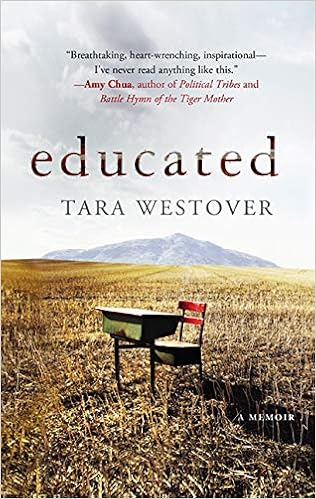
While we were on a road-trip in September, I had an opportunity to read several books.  The first one was "Educated:  A Memoir" by Tara Westover.  I had picked it up at Costco because the reviews on the cover were stellar.  And the book did not disappoint.

Tara Westover tells a realistic, yet stunning story of growing up in Idaho, in a Mormon family who refuses to register its children, refuses to send them to school, refuses to let them see the Doctor.  The father runs a scrap yard among other businesses that involve the children working in dangerous situation.  The mother becomes a midwife so women do not have to see a doctor.  Individuals  inadvertently become subject to various forms of neglect, abuse and child labor, unnecessary accidents, even though the parents are highly idealistic and religious, well-meaning in their own way.  For the child growing up this is insidious, as it knows no different life. Freeing herself from it requires all the strength Tara can muster.  It is complicated, to say the least.

For me, it is a lesson in several areas.  First of all, the depth of commitment to their lifestyle by American cultists.  In many places in the world such isolation is not possible and communities are much better integrated.  In America, however, it is possible, and in any case it is the "land of the cults" as Lutheran immigrant pastor/missionary Walther said. In Lutheran theology, the calling of the Christian person can be to be a medical doctor, a scrap yard owner, a pastor, a midwife, policeman, governor, housewife...  All these callings are God's gifts to a helpful and integrated society. With the cult, however, an alienation is essential to keep the message alive, the message of isolation and individualism.  A message of being different from other people in society.

Not that learning some survival skills would not be a good thing.  Nowadays, we are so disconnected from nature and the way things used to be done even just two generations ago, that it makes us wonder what it is to be truly human without all our helps and technologies.  Certainly, there is a tension inherent, that we can all understand.  I myself was thinking we should get a generator when North Korea was sending missiles over Japan last year.  There is the dirty bomb that could travel very far that disrupt all our communications and electrical grids. I was trying to imagine it, though I am not given to apolitical speculations.  In fact, my generation, and especially myself hailing from the former West Germany, lived in the shadow of the bomb.  How will we be able to survive when everything fails or is destroyed?  Would we even want to try?

Maybe a generator would be good, but then you need fuel...  Most of all, you would need water...

Where does it start and end.  It becomes a paranoia, more than anything.  But emergency preparedness is a sensible thing...

The book also makes me think about our current NDP government in my Canadian province.  They have a left-leaning ideology, which has manifested itself in interesting ways, so interesting that they cannot be elected again.  One of the first things, they have done, was to ram down the throats of farmers all kinds of laws regarding farm labor.  Perhaps, there are concerns I had not considered.  I know a family where all four children died in two separate farm accidents.  The marriage also ended up breaking apart. I know a farm where a toddler was run over.  But that can happen anywhere.  I know a farm where a young man nearly burned himself to death.  But had been very foolish.  I know a farm where a young Mennonite helper was electrocuted just a few weeks into the job.  No doubt, the young are at risk.  But then my own 18-year old died in a car accident.

What factors can be controlled?  In any case, the NDP should have had a consultative, bottom-up process, rather than asserted itself in the way it did, right out of the start gate alienating so many.  From then on, it also went on to alienate Christians of all stripes.  This also, was not ok.  Christians, in general, are not like Tara Westover's father and mother.  Mostly, they live in responsible, well integrated communities.  Some oversight is always a good idea, but government oppression of consciences is not.  They are your average, more or less, good citizen.  And that is what we have had in my province, as of late.  On that level, I had wondered if "Educated" is an anti-Christian book, but that would be not a fair interpretation. Overall, Westover has considered her communication carefully, and her points are well taken.  There are indeed Mormon families hiding in Canadian mountain regions trying to keep polygamous groupings intact.  These things do happen.  And children suffer.  We must support the weaker and younger elements in society.

The most memorable part of the book, however, was the philosophical and literary point of view.  Westover took a degree in history, or more like the philosophy of history, or the process of making history.  In relation to this, she comes to interesting conclusions, which one ought to read for oneself.  What hit me most is that by writing her own autobiography, she says she is "writing history", herself. 

It makes me consider all the autobiographies that have lived in my head and my life, all this time--my grandfather's, expelled from Silesia, my in-law's, fleeing Poland after the war.  Stories that have not made it to the movie screens and histories that have been expunged from the collective memory. These stories make me different from my Canadian neighbors, though many immigrant populations also have suffered through wars, famine, oppression, even persecution.  But the languages and images are different, and these communities tend to stay in their own corners. Currently, public discourse has been deluged with programs dealing with LGTBQ issues, as well as Indigenous affairs.  In some ways, it is not a surprise that we have all fractured into new subgroups of discussion groups and media consumption.  Some are becoming their own islands, their own Idahoes.  We are educating ourselves online and what does this mean?


Saturday, August 5, 2017

Funeral for German Roman Catholic Bishop

Just to mention:  I don't follow Roman Catholic teachers and bishops, but someone sent me these two links to Cardinal Meisner.  They were very interesting and somewhat edifying, but they are in the German language.  In one of them Cardinal Meisner recounts the events of his life under dictatorships and expulsion from Silesia.  Since my father and his family was expelled from Silesia, and many ethnic Germans where I live in Canada have refugee background, this was important to me, touchingly and well told.

Here is the link to the funeral.

Here is the link to the interview and life story telling.

I enjoyed the sermon at the funeral when it focused on adoration of God and how we become important and human to each other when we adore God.  It reminded me of Bonhoeffer's "Life Together", where he shows that we don't live to manipulate each other, but that we are brothers and sisters to each other in Christ, and only in Christ.  Jesus is with us and between us.  All of this made me push harder to have evening devotions with my husband, he and I now being our own little home congregation of two.

In speaking about the expulsion from Silesia, Meisner points out, how many people had to go through heroic efforts to get their families out alive in severe winter weather, traveling the roads and relying on help from strangers.  His group survived intact, but we also know of plenty of tragedies.  These things are hardly treated in the media and history telling, which is unfortunate, he observes.  Yes, spoken like a Silesian.

He also tells stories about being Catholic in East Germany and contrasts his approach to Angela Merkel's. He explains how he was moved to Cologne from Berlin, by the Pope, against his own wishes to remain in Communist Germany to bloom where he is planted, so to speak.  He obviously was a thorn in a few people's sides, but he always considered this a good sign--it meant to him that he was on the right path.

So much about that, but now I have the links here.


Image result for Cardinal Meisner

Tuesday, March 22, 2011

Funerals for German Lutherans in this area.

Today I attended and helped with a funeral in our congregation.  A dear, older, faithful member went to be with his Lord.  It was a good funeral for a wonderful gentleman originally from Silesia, where my father's family was also from.

What made me pause today was that this generation of refugees who came to this area and populated our local congregations are going to be all gone soon.  It is really a marker for me.  After that, more of our own generation will be called up.  That is another sobering thought.

How many more times will we hear stories like these:  they lived in such and such an area, they lived through the war in such and such a fashion, facing such and such tragedies or else were spared many, they became refugees/displaced, they suffered such and such deprivations after the war, they came to Canada.  These are the survivors, the emigrants, the hardy folk who taught us to save, work and sing, bake and cook.  They had many skills, or else were eager to develop them, and pushed us to succeed and make something of ourselves. They had much joi de vivre, they nurtured us, they took us camping, they were simple, good, solid folk, who kept the faith.  They had simple, down to earth but wonderful pleasures and gifts.  I am honored to have been reared by such people.  They also had traumas to overcome.  And we knew them also through our upbringing and adult life.  Some of these were never overcome. Life is good and life is very harsh.

One of the hymns of the funeral, upon insistent request, as at every other German Lutheran funeral of those who came through war, flight and emigration, was:  "So nimm denn meine Haende".  There is seemingly no funeral without this one.


I would like to type it out in English.  It is found in the Lutheran Service Book as #722.  "Lord, take my hand and lead me."   It seems to be owned by the Lutheran Book of Worship, so I will prepare my own translation for the blog, though I see that someone has put a video of it on YouTube.

1. Please take my hands and lead me
until my blessed end and to eternity.
I do not want to walk one step without you:
where ever it is you will go and stay,
please, just take me along.

2.  Please enfold my week heart with your mercy,
and make it wholly quiet in times of joy and in sorrow.
Let your poor child simply rest at your feet.
I want to just close my eyes and trust you blindly.

3.  Even when at times I might feel nothing of your power,
you are still leading me toward the goal, even through the night.
So, please, take my hands and guide me,
until my blessed end and to eternity.

It was the "even through the night" that got me today.  These people knew the night.  These people trusted those hands which held and led.  These people looked forward to their heavenly home to see the one held them in his hands.

I thank God for them and their faith.

Once more, below, my grandfather's drawing.

Monday, March 21, 2011

German Refugees in 1945

http://www.ardmediathek.de/ard/servlet/content/3517136?documentId=6770652

German TV documentary on the German refugees from the East in 1945.

My father was Silesian.  My mother-in-law and father-in-law were also refugees.

I have never seen such a documentary.  These fates have so far been rarely discussed.

Thursday, November 26, 2009

Churches in Schlesien/ Silesia--the Home of some of my Fathers


We've looked at my grandfather's picture before. (E. is for Erich, R. is my maiden name. I won't give it away here.) -- The German population is forced out of their homes en mass, never to return, including my grandfather and his children. His wife had recently died of typhoid fever. My Uncle Herbert explained a few things about the picture. See also the other post about the expulsion. This post is more about the church buildings.

There is a cross missing on the top of the page, on the tower. I've checked it out.

This is the story:

after the 30-years-war, Silesia came under Austrian Hapsburg's rule. The Peace of Westphalia dealt with all the particulars of the arrangements. Silesia became Roman Catholic.


This meant that Lutherans had only a very limited right to assemble and worship. In all of the region Lutherans were only allowed to have three "churches". They were to be built outside city walls, could not have any towers, and could be built only from wood not stone. Worship was to be at regulated times only. These churches were called the "Friendenskirchen" (peace churches) and were in Jauer, Schweidnitz and one other place.

These churches were constructed as quickly as possible to serve a huge portion of the population. Famously, they hold up to 8000 people at one time and are entirely constructed from wood. They still stand and were not bombed during WW II. They were handed over the the Polish population undamaged and now, ironically, also serve RC congregations. The towns have grown around them over time. As an aside, these buildings have become famous sites, so famous in fact that the Japanese television had a special broadcast about these churches this very month.


The buildings are interesting for the Japanese, since the Japanese also have very large wooden structures serving as places of worship. The famous Buddha by Kyoto (Nara) is located in the largest wooden building in the world. In fact, I have visited it with my sister, when she worked in Japan. Quite impressive.

So, most interestingly to me, one can find quite a bit of information on these buildings. One can also find information about the current Lutheran church in Poland, the information being mostly in the Polish language. This church calls itself the evangelical church of the Augsburg confession, which made me wonder if it was Lutheran-Lutheran or united with the Reformed. Since the site was in Polish, I could not figure it out, but my Uncle Gerhard says that they were forced-united at some point also, some century after the Peace of Westphalia.


This church in Jauer is the largest wooden church in Europe.

Now, about my grandfather's drawing and the large church behind those having to leave their homes: this particular building, after the Peace of Westphalia (1648), was another concession to the large group of Lutherans in the area. It was not a "Friedenskirche" (peace church) but a "Gebetshaus" (house of prayer), a category under which such places as synagogues fell. Again, you could not worship just when you wanted to. This building was also to have no tower under the regulations. However, at a later time the columns and the tower were added.

This "Gebetshaus" is also very large and the population had to travel from far and wide to attend services. Now, in my great-grandfather's time (late 19the century) even with village churches available by now, people still seemed to travel far distances to attend at this church in Wuestegiersdorf, so tells my Uncle Herbert. This is how my grandfather Erich, met my grandmother. They were from different towns. People would start traveling on Friday evenings (now I don't know which century we are talking about) to be able to attend church on Sunday in these large churches. The church in Wuestegiersdorf had a wonderful famous organ, to which organists from all over would make pilgrimage to play concerts on. This was a "Silbermann" organ, I am told.

At my great-grandfather's Julius' house people would tie up their horses when they had come a distance to attend church (obviously furthering the romance between my grandfather and grandmother). After church people would go ice-scating and some kind of sacks had been put on Julius' oven to warm up, so people could wear them when they went scating in cold weather. Some stories are told about these winter pleasures and socializing.

My Uncle Herbert was baptized and confirmed at this large church in Wuestegiersdorf. I don't know about my father. I'll have to ask. Uncle Herbert has been back to see the church and was disappointed to find the organ gone and the front of the church dedicated to the Virgin Mary.

The loss of their homeland is still hard for many of these people and a story that is rarely told. My Uncle Herbert knows the history of the area from his confirmation pastor and from traveling there numerous times over the years. He lives in Vancouver.

Sunday, November 15, 2009

Expulsion from Silesia


My cousin from Vancouver faxed me this today. It was drawn by our grandfather Erich.
Also, see my other post about the church building in the background.

My father would have been motherless and 11 years old.
Everyone looks so chubby. They are wearing all the clothes they have. This is what Martin's aunts and uncles did when they fled by wagon.

My grandmother had just died of Typhoid fever which she had caught from Jewish individuals who had been released from concentration camp and who were living in their house for this reason. My grandfather remarried a lady from his town whose husband had been shot on the street at random. I gained four aunts this way.

Now you know why there are so many cousins.

My grandfather's paintings still hang in the old house inhabited by the Polish now. Sometimes my uncles go back there. This summer my brother went there for the first time. I would be curious, too.


This is a picture of my gradpa Erich and my grandmother, whom I've never met, but whom I resemble. (See my cheap IKEA frames all twisted.)